Bottom line
- On speed and features I would pick NordVPN: one review measured an average speed loss of 3% against 18% for ExpressVPN, and NordVPN adds multi-hop and Onion over VPN.
- ExpressVPN is the easier app and the cheaper bill at both ends: Basic is $2.99 a month against $3.49, and it renews at $99.95 a year against $139.08.
- I score NordVPN 8.0 and ExpressVPN 7.6 on the same five checks, so NordVPN wins narrowly, and the better choice depends on whether speed or simple apps matter more to you.
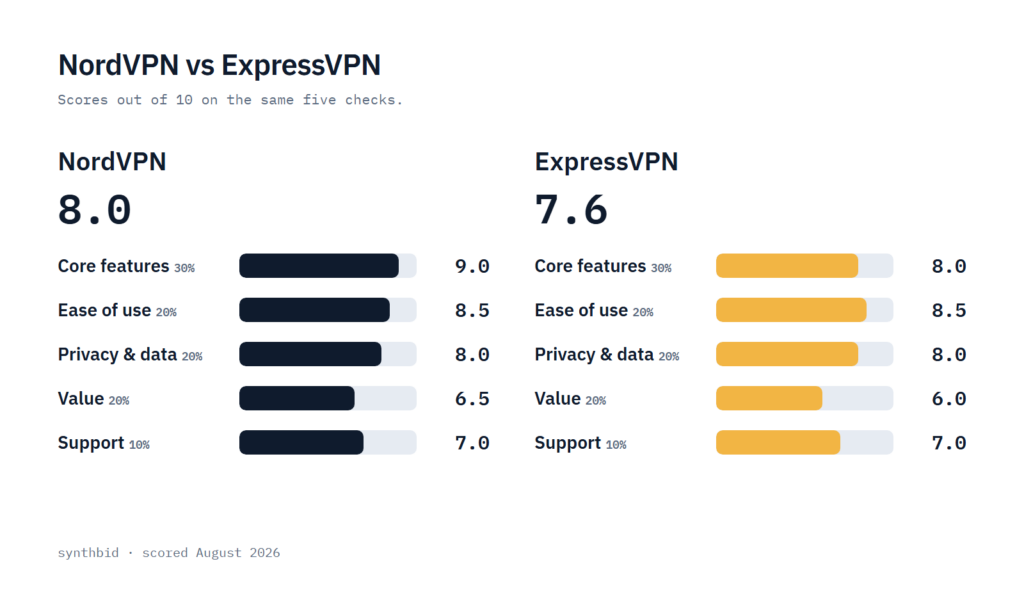
NordVPN and ExpressVPN are the two names most people end up comparing, and the sources I read agree that they are close. NordVPN wins on speed and features, ExpressVPN wins on app polish and audit transparency, and both are among the dearer VPNs once the first term ends. This comparison is about which of those gaps is big enough to decide the purchase.
The two at a glance
| NordVPN | ExpressVPN | |
|---|---|---|
| Average speed loss, one review | 3% | 18% |
| Download and upload loss, another test | 5.78% and 4.11% | 7.57% and 24.12% |
| Entry plan on a two-year term | $3.49/mo | $2.99/mo |
| Entry plan renews at | $139.08 a year | $99.95 a year |
| Devices on the entry plan | 10 | 10 |
| Legal base | Panama | British Virgin Islands |
| Independent audits counted since 2018 | Five | 23 |
| Multi-hop connections | Yes | No |
| Money-back guarantee | 30 days | 30 days |
| My total score | 8.0 | 7.6 |
Speed and servers
Speed is the clearest win for NordVPN, and two separate sets of numbers point the same way. CNET recorded an average speed loss of 3% for NordVPN and 18% for ExpressVPN in its 2025 tests, and it treats a loss of 25% or less as fast, so both clear its bar.
The second test, from Security.org, shows where the gap sits. Download speed fell 5.78% on NordVPN and 7.57% on ExpressVPN, which is close. Upload speed fell 4.11% against 24.12%, and latency was 78.3 ms against 125.8 ms. For plain streaming the download figure says there is little to choose, but if you send large files or take video calls, the upload and latency gap is the number I would look at.
Both tests are single snapshots, so read them as a direction and not a promise. My guide to VPN speed loss covers what to expect on your own line.
Server counts are where the sources fall apart. The first review counts 7,400-plus servers in 126 countries for NordVPN and 11,500 plus in 105 countries for ExpressVPN. The second counts 9,300-plus servers in 137 countries for NordVPN and puts ExpressVPN at 3,000-plus in 105 countries, though its reviewers say ExpressVPN support could not confirm an exact total. ExpressVPN’s own order page now says 113 countries. I would not decide on server counts, although NordVPN has the longer country list in both reviews.
Privacy and audits
Both services run audited no-logs policies, and both are based outside the 14 Eyes alliance: NordVPN in Panama and ExpressVPN in the British Virgin Islands. On encryption they are level, with the same two ciphers listed. The differences are in how much each one lets you check.
ExpressVPN is the more open of the two. It counts 23 independent audits since 2018 and puts the full reports in a public Trust Center, while NordVPN has commissioned five in the same period and keeps its latest reports for paying customers. The audit gap is the privacy difference I weigh most, because a report you can read is worth more than a claim you have to accept.
On the technical side, ExpressVPN’s TrustedServer setup reinstalls the whole software stack on every reboot, and it was an early adopter of post-quantum encryption. NordVPN has caught up, using the ML-KEM standard in its NordLynx protocol. ExpressVPN adds ShuffleIP, which changes your IP address for each site you visit. NordVPN has no equivalent but offers Double VPN routing and Onion over VPN, and ExpressVPN has no multi-hop option at all.
The second review also read both privacy policies and counted 14 data points kept by ExpressVPN against 20 for NordVPN, with NordVPN’s extra items including device and browser details. Neither keeps web traffic or DNS queries. I treat that as a mild point for ExpressVPN, since it comes from one source and measures policy wording, not behavior.
Ownership, warrants and past incidents are covered in my NordVPN review and my ExpressVPN review, so I do not repeat them here.
Apps, devices and streaming
CNET calls ExpressVPN the simplest VPN to use on every platform, with a minimal app that behaves the same everywhere. It finds NordVPN user-friendly but busier, especially on mobile, where the map takes over the screen. NordVPN does let you pause the connection and not only disconnect, which is handy for a short break from the VPN. Security.org looked at store ratings as of April 2026 and called the apps a draw: ExpressVPN held 4.7 stars on both stores, NordVPN 4.7 on Apple and 4.6 on Google Play.
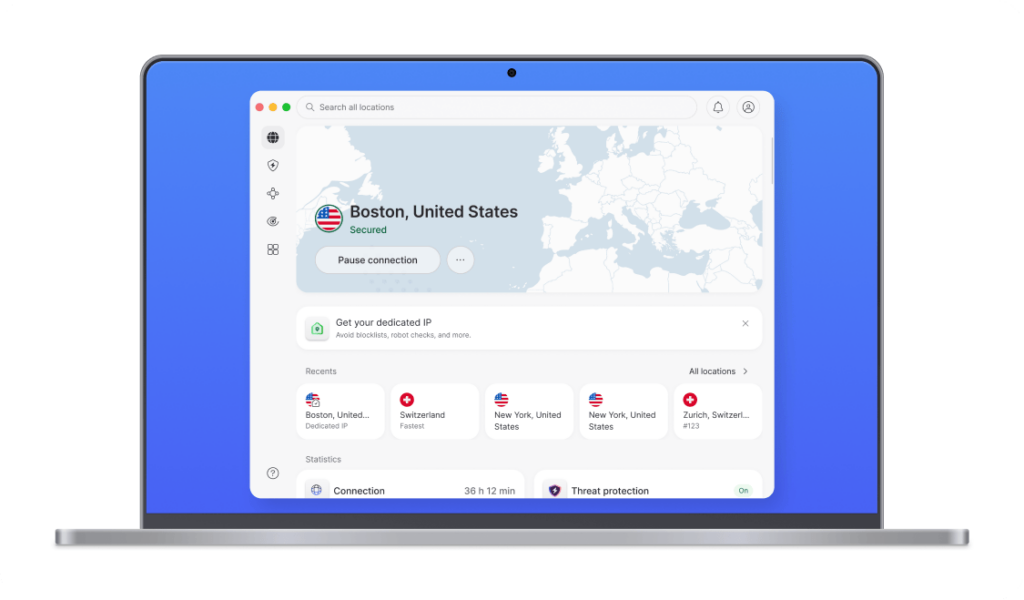
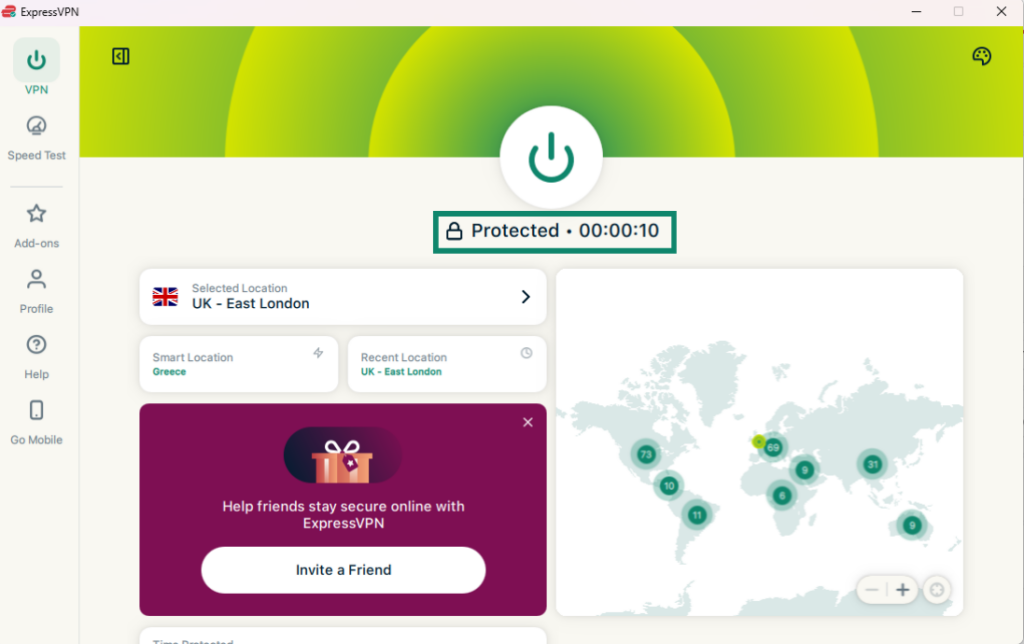
Both have apps for Windows, macOS, Linux and Chromebook, for phones on Android and iOS, for Fire TV, Apple TV and Android TV, and for routers. The difference is in the living room. The first review says ExpressVPN has by far the most intuitive router setup, thanks to a router app that also works with its own Aircove router, and a simpler Apple TV app. NordVPN has the better Fire TV Stick app, and the second review notes that NordVPN on a router means configuring it by hand.
On device limits they start level. Both allow 10 simultaneous connections on the entry plan, and ExpressVPN raises that to 12 on Advanced and 14 on Pro. Neither offers unlimited connections, so a household with more devices than that is better served by a provider that does.
Streaming is close. The first review found both services good at unblocking Netflix, Disney Plus, Hulu, Amazon Prime Video, HBO Max and BBC iPlayer, though its reviewer found ExpressVPN slightly more reliable across international Netflix libraries and could not open one catalog with NordVPN. The second review lists Netflix as working on both. Libraries change from week to week, so if one catalog is your reason to buy, check it inside the refund window.
Extras and plan tiers
NordVPN has three tiers, called Basic, Complete and Prime. The entry tier is the VPN plus DNS-level filtering of scam and phishing sites. Complete adds anti-malware, an ad and tracker blocker, call and message protection, a password manager and encrypted cloud storage of 1 TB, and some of those protections are desktop only. Prime adds credit freeze assistance on top, and a dedicated IP address is an add-on at checkout.
ExpressVPN also has three tiers, called Basic, Advanced and Pro. The entry tier is the VPN with light ad and malicious-site blocking and a small private email relay. Advanced raises the limit to 12 devices and adds tracker blocking, the ExpressKeys password manager, automated data removal and up to $3 million in identity theft insurance. Pro covers 14 devices, includes a dedicated IP and ExpressAI, and lifts the insurance to $5 million.
The same review calls the value difference razor-thin and says the right pick depends on the tools you need: ExpressVPN if you want a password manager and identity features, NordVPN if you want malware protection and cloud storage. I would choose by which extras you would otherwise buy separately. If automated data removal is the draw of ExpressVPN’s Advanced tier, compare it with a dedicated service such as the one in my Incogni review before you pay for the tier.
Pricing
| Plan | Price | Billed | Renews at |
|---|---|---|---|
| NordVPN Basic | $3.49/mo | $94.23 for the first 27 months | $139.08 a year |
| NordVPN Complete | $4.49/mo | $121.23 for the first 27 months | $219.48 a year |
| NordVPN Prime | $7.49/mo | $202.23 for the first 27 months | $296.28 a year |
| ExpressVPN Basic | $2.99/mo | $83.72 for the first 28 months | $99.95 a year |
| ExpressVPN Advanced | $4.49/mo | $125.72 for the first 28 months | $119.95 a year |
| ExpressVPN Pro | $7.49/mo | $209.72 for the first 28 months | $199.95 a year |
Prices from the NordVPN and ExpressVPN pricing pages, checked August 2026.
Both long plans add bonus months, which is why the first terms are odd lengths. NordVPN’s two-year plan runs 27 months with 3 extra, and ExpressVPN’s runs 2 years plus 4 months, so 28 in all. The monthly figures follow from the totals: 27 × $3.49 = $94.23 and 28 × $2.99 = $83.72.
The renewal column is where the two part ways. On the entry plan, NordVPN renews at $139.08 a year and ExpressVPN at $99.95, a gap of $39.13 in the first year after the introductory term. At the middle tier the same introductory price of $4.49 leads to $219.48 a year for NordVPN Complete and $119.95 for ExpressVPN Advanced. The first review reaches the same view, saying ExpressVPN’s renewal price is easier to accept.
Month to month, NordVPN Basic is $14.99 on its pricing page. The ExpressVPN order page I saved lists only two-year plans, so for its shorter terms I rely on the second review, which gives $12.99 a month and $4.99 a month on a one-year plan against $5.49 for NordVPN. The same table puts ExpressVPN’s two-year price at $2.79 a month, while the order page says $2.99, so promotions move and I would confirm the price at checkout. That review’s text says ExpressVPN is cheaper at every length, yet it names NordVPN the winner on price, and I follow the figures and not the label.
Both plans carry a 30-day money-back guarantee, and ExpressVPN’s is for new users. Neither pricing page I saved lists a free plan or a free trial, so the refund window is your safety net with either one.
How they scored
Core features: NordVPN 9.0, ExpressVPN 8.0. NordVPN leads on speed, multi-hop, Onion over VPN and reach, and its bundle goes further. ExpressVPN has no multi-hop, and its speed-loss figures are worse in both tests.
Ease of use: NordVPN 8.5, ExpressVPN 8.5. The first review gives ExpressVPN the edge and the second calls it a draw. I land on a tie because the gap the first review describes shows up mostly on mobile and Apple TV, and NordVPN has the pause option and the better Fire TV app.
Privacy and data: NordVPN 8.0, ExpressVPN 8.0. ExpressVPN wins on audit transparency and NordVPN on privacy features, and each lost points for different reasons that my full reviews set out.
Value: NordVPN 6.5, ExpressVPN 6.0. Both are low because both renew far above the first-term price. ExpressVPN’s entry plan is cheaper at every term I could read, but NordVPN gives you faster speeds and a longer feature list for 50 cents more a month at the entry tier, and I keep the half point gap from my separate reviews.
Support: NordVPN 7.0, ExpressVPN 7.0. Neither source compares support closely, so it does not separate them.
The five scores combine with the weights on the How I test page into totals of 8.0 for NordVPN and 7.6 for ExpressVPN.
Which one I would pick
NordVPN fits you if speed is the deciding factor, particularly uploads and video calls, or if you want multi-hop, Onion over VPN, a password manager and cloud storage in one subscription. Note the renewal date on day one, because NordVPN is the more expensive of the two once the introductory term ends.
ExpressVPN fits you if you want the simplest app on every device, the easiest router and Apple TV setup, public audit reports and a lower renewal. It is the one I would hand to someone who has never used a VPN.
If neither fits, because you need more than 10 devices or you want a free plan to try first, look past both. My Proton VPN review is where I would go if audit record and a free tier matter more to you than raw speed.
FAQ
Is NordVPN better than ExpressVPN?
On my scores, narrowly: 8.0 against 7.6. NordVPN is faster in both published tests I read and has multi-hop, while ExpressVPN has the simpler apps, more audits and a lower renewal. Which is better for you depends on whether speed or ease matters more.
Is Netflix blocking NordVPN?
Not across the board. The first review found that both services unblock Netflix, though its reviewer could not reach one international catalog with NordVPN that ExpressVPN opened. Streaming access shifts over time, so test the catalog you care about inside the 30-day refund window.
Which is cheaper, NordVPN or ExpressVPN?
ExpressVPN at the entry tier, on the pricing pages I saved. Its plan costs $2.99 a month, where NordVPN’s costs $3.49, and ExpressVPN renews at $99.95 a year, where NordVPN renews at $139.08. The gap is wider at renewal than at signup.
How many devices can I use?
Both entry plans allow 10 simultaneous connections. ExpressVPN allows 12 on Advanced and 14 on Pro, while NordVPN stays at 10 on every plan.