Bottom line
- ExpressVPN is the VPN I would suggest to someone who wants apps that behave the same on every device and a long record of independent audits, and who accepts paying more than rivals charge.
- The headline price is $2.99 a month for Basic on the 28-month plan, but it renews at $99.95 a year, close to triple that monthly rate, so I would set a reminder before the first term ends.
- It is not the broadest VPN: there is no multi-hop, Basic covers 10 devices, and its fastest protocol, Lightway Turbo, runs only on Windows.
ExpressVPN is the VPN I would hand to someone who wants to install it, press one big button and get on with the day, and who is happy to pay for that comfort. The trade-off is the bill. It now sells three tiers, and the VPN-only tier is the one that renews at a price I would not call cheap. Most of this review is about what each tier gives you and whether the audits, the apps and the speed justify the premium.
What works
- The apps look and work the same on desktop and mobile
- Independent audits, 23 of them, with the reports public
- RAM-only servers and a base in the British Virgin Islands
- A kill switch on every platform and post-quantum protection
What doesn’t
- Basic renews at $99.95 a year, well above the first-term rate
- No multi-hop connections
- The device limit is capped by tier, with no unlimited option
- Lightway Turbo, its fastest protocol, is Windows only
What you are buying
ExpressVPN now sells three tiers called Basic, Advanced and Pro, with the VPN included in each. Basic is the VPN plus a stripped-down ad and site blocker and a small allowance of private email relay, for 10 simultaneous devices. Advanced allows 12 devices and adds tracker blocking, the Keys password manager, identity alerts with theft insurance and a short free eSIM. Pro allows 14 devices and brings a dedicated IP address and ExpressAI, a private chatbot.
A dedicated IP is an add-on for the two lower tiers, and one review lists it at $3.99 to $8.99 a month depending on the term. Reviewers do not agree on which tier to buy. One names Advanced the best value and sees little extra in Pro, while another calls Pro worth it if you want a dedicated IP, since that is rarely bundled. I would start from Basic, move up to Advanced only if you will use the password manager and tracker blocking, and look at Pro for the dedicated IP and nothing else.
Apps and everyday use
There are apps for Windows, macOS, Linux, Android and iOS, plus versions for Android TV, Samsung TVs and the main game consoles, and browser extensions for Chrome and Firefox. The extension works as a remote control for the installed app, so it does not act as a separate proxy that protects only the browser.
Consistency is the selling point. PCMag says the Mac and iPhone apps follow the same design as the Windows one and counts it among its favorite choices for both. A recent redesign made the Windows dashboard busier, with a map, connection details and an in-app speed test, though settings now live in the main window instead of pop-ups. Another counted 13 clickable elements on that dashboard against 23 on NordVPN and on Surfshark, so it is still the plainer of the three.
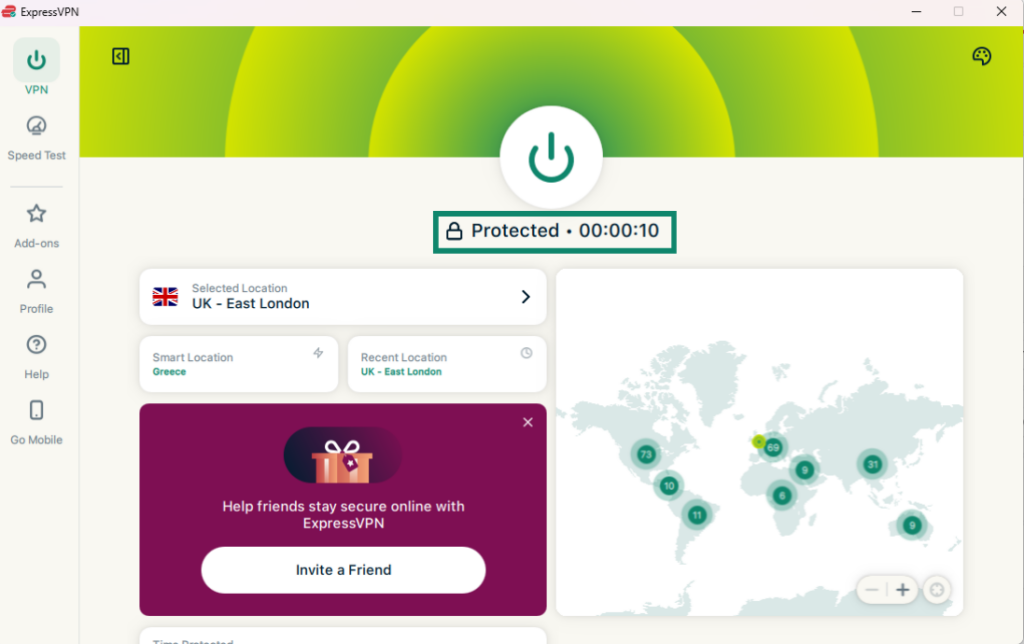
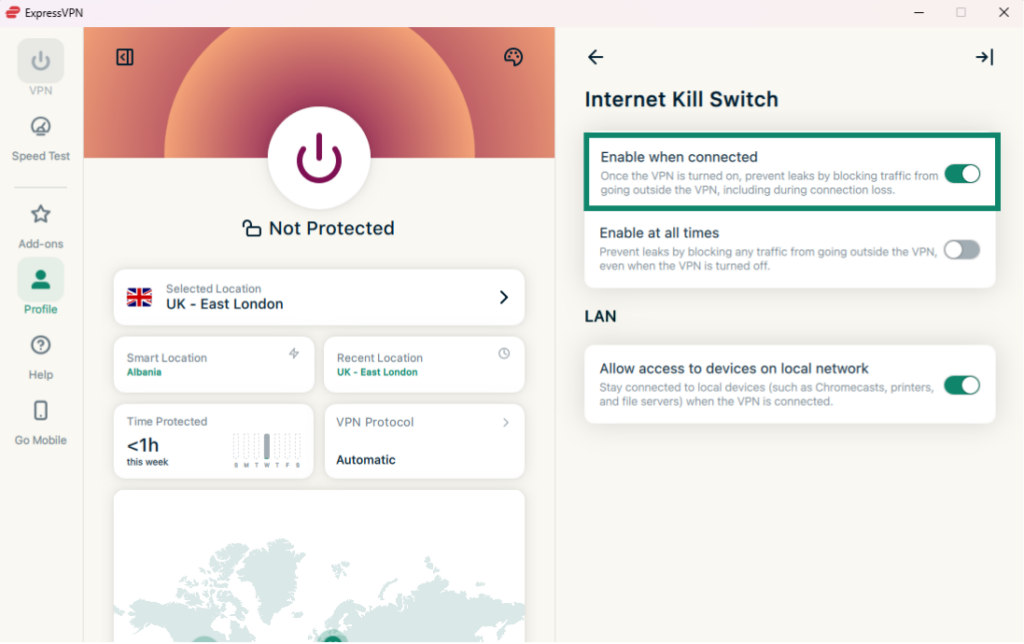
The settings that matter are all present. The kill switch exists on every platform and held up when testers cut the connection in several ways, and split tunneling is there on Windows, Android and macOS. Reviews disagree about iOS, where one lists split tunneling and another says it is missing, so check before you rely on it.
Two features are absent. There is no multi-hop, which sends traffic through two servers, and ExpressVPN says that is deliberate because it adds complexity and slows connections. There is also no port forwarding, which it says carries too many security risks. On devices, the cap is set by tier, and a reviewer says the high prices make that cap harder to accept when TunnelBear offers unlimited connections for less. A router setup can bypass the limit because the router counts as one connection.
Servers, speed and streaming
Server counts depend on who is counting. One review counts roughly 3,000 servers in 105 countries and another counts 108 countries. The coverage reaches regions such as Africa and South America, and ExpressVPN is open about which locations are virtual, although that disclosure sits on a web page and not inside the app.
Published speed tests give a mixed picture. In one set of figures download speed fell 15.48%, upload speed fell 13% and latency rose 109.40%, which the tester calls above average but short of NordVPN. Another reviewer reported an 18% overall speed loss in 2025 testing, the third best of the services tested.
The result depends heavily on the protocol. In TechRadar’s lab, Lightway Turbo reached 1177 Mbps on Windows, while standard Lightway managed only 428 Mbps over a local connection, against 967 Mbps on WireGuard. A different reviewer saw standard Lightway cut speed by only 8% on a Mac, so the two disagree and I would not treat either as final. If you are not on Windows, I would try WireGuard and Lightway in turn and keep whichever is faster on your line.
Streaming results also differ. In one review Netflix opened in the US, UK, Australia and Canada and was blocked in Japan, while another struggled with the Australian and Japanese libraries and with Prime Video, yet got into UK and Australian broadcaster sites first time. Two others unblocked every service they tried. Unblocking shifts from week to week, so if a single library is why you are paying, test it inside the 30-day refund window for new users.
Privacy, audits and ownership
The privacy policy says ExpressVPN keeps no record of browsing history, DNS queries, your IP address, connection timestamps or session length, as one review quotes it. It does keep a few summary figures, which a reviewer lists as the data transferred, the date of your last connection and the country you last connected to. The company is based in the British Virgin Islands, which has no data retention laws, and its servers run from RAM and have their whole software stack reinstalled on every reboot.
The audit record is the part I rate most. PCMag and CNET both count 23 independent audits, covering the apps, the browser extension, the router and the Lightway protocol, with the full reports available to read. The newest was done by Cure53 in February 2026, and KPMG has checked the TrustedServer system against the privacy policy. Transparency reports arrive every six months. The latest one covered 2025, with 374 requests from authorities and 1,063,598 DMCA notices, and none ended in user data being handed over.
Ownership is where I take points off. ExpressVPN belongs to Kape Technologies, which was once called Crossrider and rebranded after criticism over adware. Kape also owns CyberGhost, Zenmate and Private Internet Access, and one reviewer says it owns affiliate review sites that push its products, which is a reason to read any glowing ExpressVPN write-up with care. Another review argues the Crossrider story is more complicated than many articles claim and that Kape has distanced itself from it.
The security lapse I weigh most is a DNS leak. In February 2024 ExpressVPN disclosed a DNS leak in its Windows app that had been active since May 2022, and it affected people who used split tunneling. The company removed the feature, built a fix within six days and commissioned an audit of it. A leak that ran for years before anyone noticed is a mark against any VPN, and I weigh the fast fix and the audit in its favor.
Extras on the higher tiers
Keys, the bundled password manager, covers the basics: it imports passwords, generates new ones, fills logins and stores cards. It has no passkeys or sharing and some users complain about autofill, while another reviewer found it worked on every site tried. I would treat it as a convenience, and if passwords are a priority I would compare it with the dedicated manager in my Bitwarden review.
The ad and site blocker is the weaker extra. It worked on text sites and only some YouTube videos, with ads still showing on Netflix and Twitch, and the adult-site filter let Reddit through. In one check the blocker stopped 84% of phishing pages but only 16% of the malware links. I would not use it in place of antivirus. Identity alerts, a private email relay and a short free eSIM complete the list, and I would count them only if you would otherwise pay for something similar.
Support
The chat bubble opens an AI assistant that draws on the help articles, and you can ask for a person. The chat team was helpful and ticket replies were knowledgeable within a few hours. Another review lists live chat around the clock plus email, and its agent connected after a few minutes and listened to the question instead of reciting scripts.
Cancelling is handled by support. The agent used scripted messages asking the customer to stay and to explain the reason, then processed the refund in a few minutes once the request was firm. It is one more reason to note your renewal date and act before it, not after.
Pricing
| Plan | Price | Billed | What it adds |
|---|---|---|---|
| Basic | $2.99/mo | $83.72 for the first 28 months, then $99.95 a year | The VPN, a light ad blocker and private email relay |
| Advanced | $4.49/mo | $125.72 for the first 28 months, then $119.95 a year | Everything in Basic, plus tracker blocking, a password manager and identity alerts |
| Pro | $7.49/mo | $209.72 for the first 28 months, then $199.95 a year | Everything in Advanced, plus a dedicated IP and ExpressAI |
Prices from ExpressVPN’s pricing page, checked June 2026.
The page presents these as a limited-time offer of up to 80% off. The long plans run 2 years plus 4 bonus months, so the real billing term is 28 months, and the arithmetic holds: $2.99 × 28 = $83.72. All three tiers carry a 30-day money-back guarantee for new users.
Published prices for the same plan do not match. One review lists $78.18 for the first 28 months of Basic, another lists $97.72, and a third has the two-year Basic plan at $3.49 a month, against $2.99 a month on the page I checked. The promotion appears to move, so confirm the figure at checkout. Month to month, Basic costs $12.99, which makes the monthly plan an expensive way to try the service.
The part to plan around is renewal. Basic renews at $99.95 a year, which is $99.95 ÷ 12 = $8.33 a month, close to triple the headline rate. Advanced and Pro renew at $119.95 and $199.95 a year. One reviewer says you have to work through the bonus months and the yearly renewal math to see what you are paying, and another calls the Basic renewal steep for what the tier includes. If you pick a long term, put the renewal date in your calendar.
How it scored
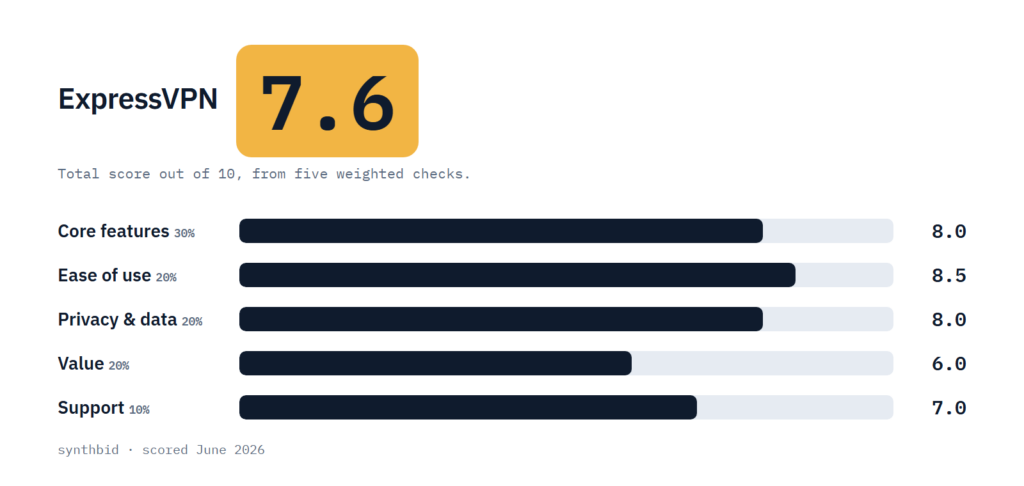
Core features, 8.0. A kill switch on every platform, split tunneling on most, three protocols, post-quantum protection in Lightway and RAM-only servers cover what I look for. I stop at 8.0 because there is no multi-hop or port forwarding, the fastest protocol is Windows only and the extras are thin next to rivals.
Ease of use, 8.5. The apps look and work alike everywhere, the install is simple, and reviewers say they suit people who have never used a VPN. I hold it below 9.0 because the redesigned dashboard is busier, keyboard navigation got worse and cancelling goes through support.
Privacy and data, 8.0. Audits, public reports, RAM-only servers, a privacy-friendly base and a no-logs policy that auditors have examined are strong. I take points off for the Kape ownership, the Windows DNS leak that ran for years, and the summary usage data it does keep.
Value, 6.0. This is the weakest score. Basic renews at close to triple its headline rate, reviewers say other VPNs give more for less, the device cap is lower than the unlimited allowance some competitors offer, and the extras that justify the higher tiers are not strong. Advanced is the better deal of the three.
Support, 7.0. Round-the-clock chat, quick ticket replies and a fast refund are good. An AI assistant answers first and cancelling involves scripted retention messages. It is solid without being distinctive.
Once the five scores are weighted, ExpressVPN totals 7.6, and the method behind that weighting is on How I test.
Alternatives worth a look
NordVPN
Pick it if speed is your priority, since a published lab test ranked it fastest. Check the renewal terms first, and my NordVPN review explains why.
Mullvad
Pick it if payment privacy matters more than polish. One review points to it for cash payments, which ExpressVPN does not list. I cover it in my Mullvad review.
Surfshark
Pick it if you have more devices than ExpressVPN allows, since its base plan has unlimited simultaneous connections.
FAQ
Does ExpressVPN have a free trial?
There is no free plan. The pricing page lists a 30-day money-back guarantee for new users, which is how I would try it. One review mentions a 7-day trial through the iOS and Android app stores, but the pricing page does not, so I would not count on it.
How many devices does ExpressVPN allow?
Basic allows 10 simultaneous devices, Advanced 12 and Pro 14. There is no unlimited tier, though a router running ExpressVPN counts as a single connection.
Who owns ExpressVPN, and where is it based?
It is based in the British Virgin Islands and owned by Kape Technologies, formerly called Crossrider. Kape also owns CyberGhost, Zenmate and Private Internet Access.
How do I cancel ExpressVPN?
Contact support, which processed one reviewer’s refund in a few minutes after some scripted attempts to keep the customer. Basic renews at $99.95 a year after the first term, so set a reminder before the date.