Bottom line
- Mullvad charges a flat €5 a month, whether you top up for one month or for ten years, and an account number takes the place of the usual email and password.
- Published speed tests disagree on how much it slows you down, and streaming access is its weak spot, so I would not buy Mullvad mainly to watch Netflix.
- Nothing renews by itself and each account covers 5 devices, so the price of the privacy is some manual upkeep and a device cap.
Mullvad is a VPN for people who care more about what a provider knows about them than about what extras it bundles. The trade-off that matters is convenience: you get one simple price and almost no account data, and in return you give up strong streaming support, a large server list and any automatic billing. Most of this review is about whether that swap suits you.
What Mullvad is
Mullvad is a Swedish VPN with one product at one price. There is no free plan, no ladder of tiers and no bundled password manager or antivirus, so the service stays focused on the tunnel itself. The company is based in Gothenburg, and one published review says it neither pays for reviews nor runs affiliate deals, which means no referral arrangement is steering what gets written about it.
The company is also old by VPN standards. Its pricing page says the €5 rate has not moved since the service launched in 2009, which few competitors running yearly promotions could say about their own prices.
What works
- A flat €5 a month at every plan length, unchanged since 2009
- No email, username or password: an account number is the login
- Cash, Bitcoin, Monero and card payments, with 10% off for cryptocurrency
- RAM-only servers and 18 independent audits, the latest in early 2026
What doesn’t
- Only 5 devices per account
- Netflix opened only in the US and Canada in one set of checks
- A small network, with counts from 578 to 703 servers in the reviews
- No live chat, and nothing renews by itself, so you must remember to top up
Account and payments
When you start, one click generates an account and hands you an account number, and only then do you choose how to pay. There is no email address, username or password to create, so that number is the whole login. I would keep it in a password manager, such as the one in my Bitwarden review, because a published review warns readers not to lose it.
Payment options run from ordinary to unusual. Cards, PayPal and bank wire all work, and so do Bitcoin, Bitcoin Cash and Monero, with 10% off for cryptocurrency because of lower fees. You can also post cash in an envelope together with a payment token generated on the site, and the company credits your account number once the envelope arrives.
Paying by card or PayPal is fine, but those payments are identifiable at the payment service even though they are not linked to what you do online. One comparison priced a year paid directly at around $70, against around $55 for a Mullvad card bought on Amazon, which is also a way to avoid giving Mullvad any payment details at all.
Apps and everyday use
Mullvad has apps for Windows, macOS, Linux, iOS, Android and Android TV, and all of them are open source. Each account works on up to 5 devices, which is tighter than the unlimited connections that providers such as Surfshark now offer. For a household with a lot of gadgets, that cap is the first thing I would check.
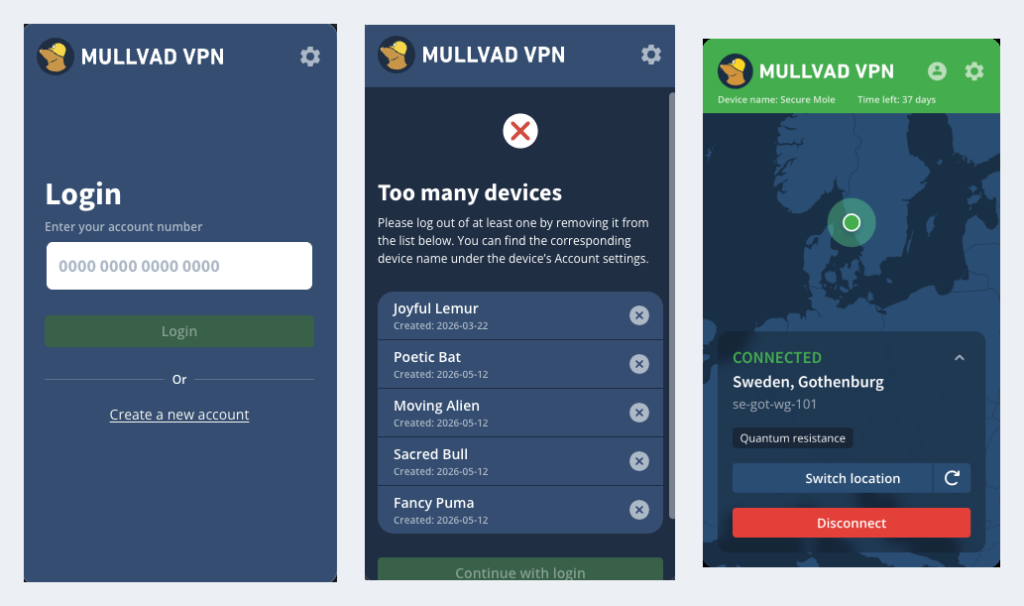
The apps look plain and stay consistent from one platform to the next. Reviewers disagree about the Windows design: one finds the cramped panel pinned to a screen corner awkward and wants a larger window, while another calls it clean and modern and points out that the pinning can be changed in settings. I would call it functional and not pretty, and I would not weigh it heavily.
The server list is better than the app’s looks. You can drill from a country to a city to a single server, read details such as the hosting provider and current load, and filter by provider or by whether Mullvad owns or rents the machine, an option the reviewer had not seen elsewhere.
Streaming boxes are thinner. CNET says Mullvad works on Android TV and may be sideloaded onto a Fire TV Stick, and it advises going with Proton VPN if you want a native app on Fire TV or Apple TV.
Features that matter
Mullvad offers multi-hop, which routes traffic through two servers you choose, and split tunneling, though split tunneling is missing on iOS. Multi-hop costs speed, and anything you exclude with split tunneling is visible to your internet provider again, so I would switch either on only for a specific job.
DAITA is the feature that sets Mullvad apart. It adds junk data and evens out packet sizes so that patterns in encrypted traffic are harder to read, and it slows the connection while it does so. One review says most users will never need it. I agree, and I would only bother if your worry is more than a nosy network.
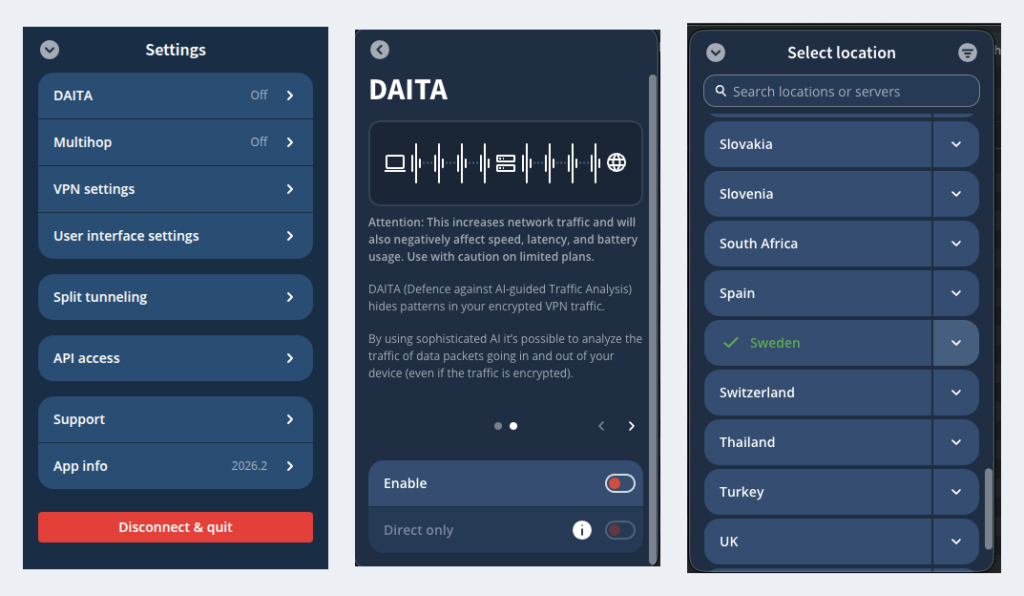
Since 2024, every WireGuard connection has used quantum-resistant encryption by default, and the kill switch is on by default, with a stricter lockdown mode that blocks anything outside the VPN. WireGuard is now the only protocol, because OpenVPN has been phased out. Its new GotaTun code, written in Rust, was already running on Android at the time of that review.
Two omissions are worth knowing. Port forwarding was removed in 2023 on security grounds, which I would check first if you run torrent software that depends on it, and there are no extras such as a password manager or a malware scanner. A DNS blocker covers ads, trackers and malware, but Mullvad itself says it is not a replacement for antivirus.
Speed and streaming
The published speed results do not line up. One test recorded downloads down 8.04%, uploads down 5.54% and latency up 74.78%. Another put the average loss at 24%, and a third averaged 53% of baseline download speed across servers in different countries over several days. The methods differ, so I read them as a range, and all three still call Mullvad fast enough for everyday use.
Streaming is where Mullvad is weakest. In one set of checks Netflix opened only in the US and Canada, out of five countries tried. Another reviewer found that most streaming sites blocked it apart from Netflix and HBO Max, and a third called it hit or miss from server to server. Proton VPN unblocked every streaming site in that same comparison, so streaming is the reason I would look elsewhere first.
Privacy and trust
Mullvad says it does not log traffic, DNS requests, connection timestamps, IP addresses or bandwidth use. The little it does keep is operational: the number of current connections on its network, CPU load per core, bandwidth per server and a live count of connections per account to enforce the device limit. That is a short list, and as far as the policy describes it, none of it records what one person did online.
Servers run from memory only. Mullvad finished moving to diskless servers in 2023, including the machines it rents and not only the ones it owns, so nothing persists if hardware is taken.
The audit record is long. One review counts 18 independent audits, the latest in early 2026 by Assured Security Consultants. PCMag credits GotaTun with a 2026 audit, but PCWorld describes GotaTun as Mullvad’s own WireGuard implementation, so I treat that line as a slip and use the PCWorld account.
The company has also faced a real legal demand. Mullvad says Swedish police arrived with a search warrant in April 2023 and left empty-handed, and it says it would shut the service down before agreeing to spy on its users.
The one mark against it is jurisdiction. Sweden belongs to the 14 Eyes intelligence-sharing alliance, which worries some privacy advocates, while Proton VPN’s Swiss base sits outside it, as a comparison of the two points out. With so little data held, I do not think that is a serious weakness, but it is why I stop short of a perfect privacy score.
Support
Support is by email only, with no live chat. A reviewer had an answer within one hour, with detailed replies that pointed to help articles, and the same review praises the knowledge base for filters by feature, platform and protocol. Since you handle your own top-ups, I would want a chat option for routine billing questions.
Pricing
| Plan | Price | In dollars | Notes |
|---|---|---|---|
| 1 month | €5 per month | about $5.63 a month | Add time by hand |
| 1 year | €5 per month | about $67.56 for the year | Same monthly rate |
| 1 decade | €5 per month | about $5.63 each month | Not a term I would choose |
Prices from Mullvad’s pricing page, checked June 2026.
The price is quoted in euros and includes VAT, and the page converts it to dollars at its own rate. Reviews convert it to anything from $5.26 to $5.90 depending on the day, so expect the dollar figure on your card to drift while the euro price stays put.
The rate is the same for every term, which is why a year works out simply: €5 × 12 = €60, or $5.63 × 12 = $67.56 at the page’s conversion. That makes it cheap for one month and no cheaper for ten years, and one reviewer notes that over a long term it can cost more than a discounted rival. I would pay for what I expect to use and top up again later.
The usual renewal trap does not exist here, because Mullvad stopped taking recurring payments in 2022 to avoid keeping payment data, and many other providers raise prices sharply after the first term. The risk is the opposite one: if you forget to top up, the service stops. The Windows app shows the time left on your account, and I would set a calendar reminder a week before it runs out.
There is no free plan and no sales, even at holidays. A 14-day money-back guarantee is the way to try it, except for cash payments, which are excluded because of anti-money laundering rules.
How it scored
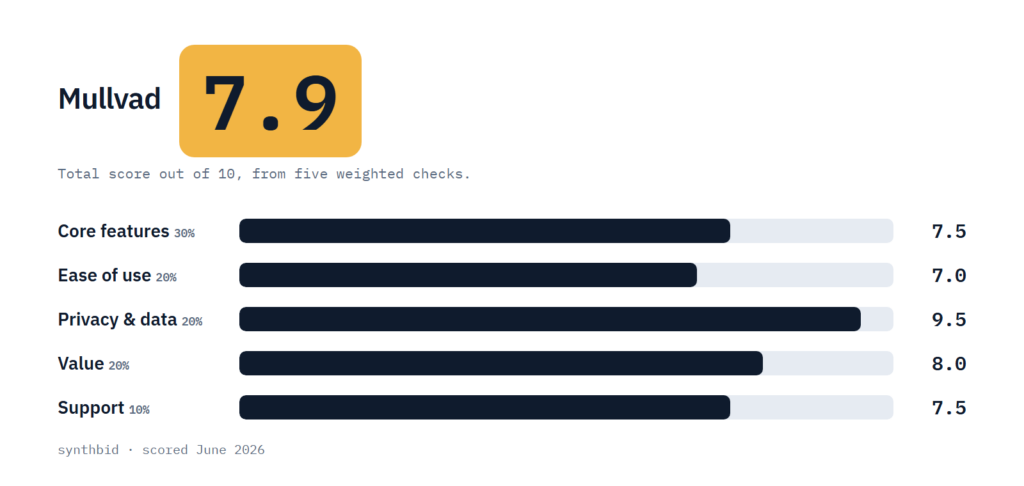
Core features, 7.5. The tunnel is strong: multi-hop, DAITA, quantum-resistant encryption by default, a default-on kill switch and lockdown mode. I took points off for a small server network, WireGuard as the only protocol, no port forwarding, weak streaming support, a cap of 5 devices and nothing beyond the VPN.
Ease of use, 7.0. Creating an account takes one click and the apps are consistent across platforms. I held it at this level because reviewers call the desktop design awkward or dated, because top-ups are manual, and because the account number is your only way back in.
Privacy and data, 9.5. No email at sign-up, optional cash payment, a short list of retained operational data, RAM-only servers, open-source apps, 18 independent audits and a reported refusal of a search warrant. Each of these can be checked, which is why this is a top score, and the jurisdiction point above is why it is not a perfect one.
Value, 8.0. A flat €5 with no renewal jump and a 14-day refund is good value, and a reviewer puts the average price among VPNs it covers at around $10 a month. I did not go higher because there are no promotional rates, long terms cost more than a discounted rival, and a large household may outgrow the device limit.
Support, 7.5. Email replies are quick and the knowledge base is deep, but there is no live chat for urgent or billing questions.
The weights are explained on the How I test page, and they give Mullvad a total of 7.9.
Alternatives worth a look
Proton VPN
A better fit if streaming matters to you. It has a free plan, and in one comparison it allowed 10 simultaneous connections and unblocked every streaming site tested.
NordVPN
Choose it for a larger network and bundled extras, but look up what it renews at first. I cover it in my NordVPN review.
Surfshark
Choose it when you have many devices, since it offers unlimited connections where Mullvad stops at a fixed cap.
FAQ
Does Mullvad have a free trial?
No. The pricing page says there is no free plan and no sales. Instead there is a 14-day money-back guarantee that covers everything except cash payments, and that is the practical way to try it.
Can I pay for Mullvad without giving my name?
Yes. An account number replaces a login, and the pricing page lists cash by post and several cryptocurrencies, which are discounted by 10%. Cards and PayPal also work but leave a record at the payment service.
Does Mullvad keep logs?
Mullvad says it keeps no logs of traffic, DNS requests, timestamps, IP addresses or bandwidth use. It keeps only operational counts, such as current connections per account, and it is based in Sweden.
Does Mullvad renew automatically?
No. It ended recurring payments in 2022, so you add time to your account by hand when it runs low, and the service stops when the time runs out.