Bottom line
- Proton VPN has a privacy record few VPNs match: a Swiss base, open-source apps and four published no-logs audits, the latest in August 2025.
- The free plan carries no data limit and shows no ads, but it covers 1 device and picks a server in one of 10 countries for you, so I treat it as a way to try the app and not as a full VPN.
- The paid Plus plan is $3.49 a month on a 24-month term and then renews at $83.88 a year, which roughly doubles the monthly rate, so I would note the renewal date at signup.
Proton VPN suits people who put privacy first and want a free plan to try before they pay. The trade-off I would weigh is performance at the edges: latency rose sharply in one lab’s tests, and the free plan is small on purpose. Most of this review is about where the free plan stops and what the paid plan adds.
What Proton VPN is
Proton VPN is the VPN product of Proton AG, a company based in Geneva that also makes encrypted email, a password manager, a calendar and cloud storage. It sells a free plan, a paid VPN plan called VPN Plus, and Proton Unlimited, which bundles the VPN with the rest of those apps.
Unlike providers that split the VPN into several tiers, Proton has a single paid VPN plan, so every VPN feature is in Plus whichever length you buy. The term changes the price and nothing else. That makes the choice simpler than at most rivals: free, Plus, or the full bundle.
What works
- Swiss company, open-source apps and four published no-logs audits
- A free plan with no data cap and no ads
- Secure Core multi-hop and Tor over VPN on the paid plan, plus port forwarding
- 10 devices at once and 20,000+ servers in 140+ countries on Plus
What doesn’t
- Latency rose by a median of 351.26% in one set of published tests
- The free plan is limited to 1 device, medium speed and no streaming or P2P
- The monthly rate roughly doubles when the first term ends
- Live chat is for paying customers, and one review found it was not available around the clock
The free plan and its limits
Proton’s pricing page lists the free plan at 1 device at a time, medium VPN speed and servers in 10 countries that are randomly selected, with no credit card required. You still need a Proton account and the app. The free-plan page adds that it has no ads and no logs and is paid for by the people who subscribe.
The part that makes it unusual is the missing data cap. One review found no limit on upload or download volume, and set that against free plans from TunnelBear and Windscribe that stop at 2GB and 10GB a month. Reviews disagree on how many servers you get: that review counts eight servers, an earlier one counts five countries, and the official page now says 10 countries. I go with the official page, since it is the newest.
What you give up is the reason most people buy a VPN. The pricing page lists streaming, P2P and the NetShield ad blocker as paid features, and because the 10 countries are randomly selected you cannot choose where you connect. You also get no live chat. I would use the free plan to check that the apps work on your devices and your network, then decide whether the paid features justify the price.
What the paid plan adds
Plus raises the limit to 10 devices at once and opens the whole network, which the pricing page puts at over 20,000 servers in more than 140 countries. It also adds streaming support, P2P, the NetShield blocker for ads, trackers and malware, and priority support with live chat.
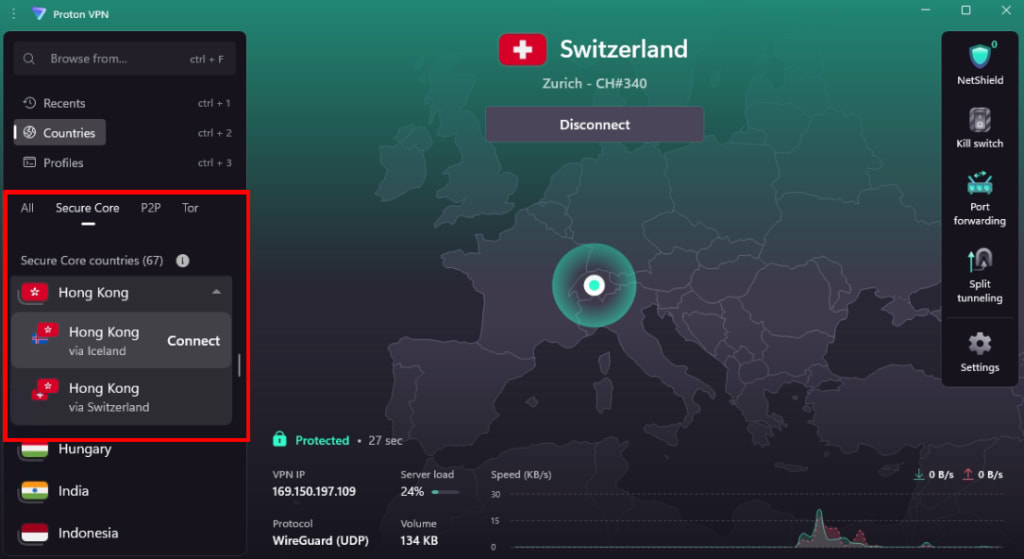
Secure Core is the feature that separates Proton from most rivals. Your traffic goes first to a Proton-owned server in Sweden, Switzerland or Iceland and only then to the server you picked, and one review counts 68 exit countries out of the 145 it lists. Tor over VPN is also included. Both slow the connection, so I would switch them on for a specific need and not leave them on all day.
Beyond those, Proton offers port forwarding, which helps torrent speeds and which many VPNs leave out. Profiles let you save a combination of server type, country, protocol and NetShield setting and apply it in one tap, and the Stealth protocol disguises VPN traffic as ordinary web traffic for networks that block VPNs.
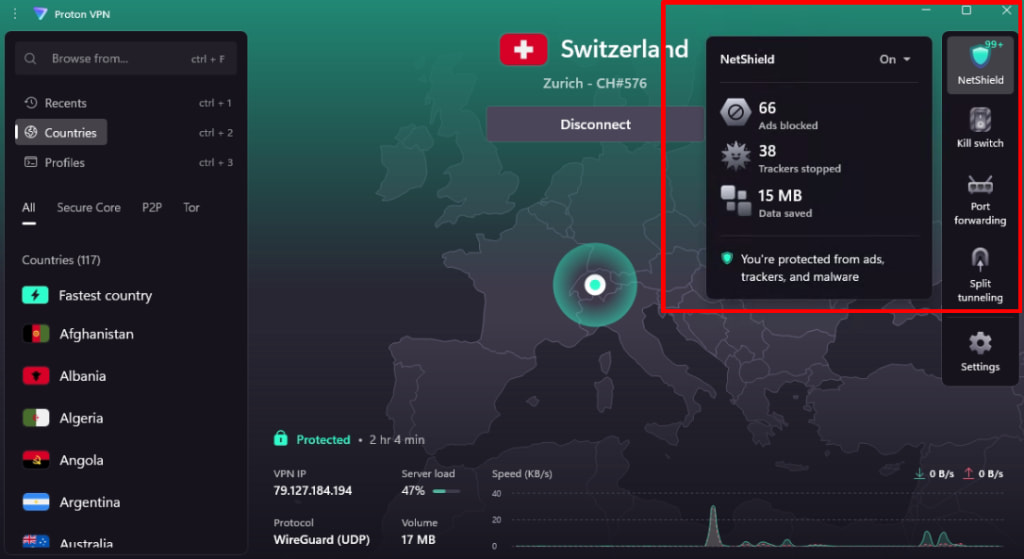
NetShield is where I would be careful. In a lab check against 36 new threat sites, it blocked 88% of ads but only 32% of phishing sites and 4% of malware sites, so I would treat it as an ad blocker and keep a real security tool for the rest. The two main reviews also disagree on protocols: the older one lists OpenVPN on every platform, while the newer one says native OpenVPN is now limited to the Windows app. If OpenVPN matters to you on a phone or a Mac, confirm it before paying.
Speed and streaming
The speed evidence is mixed, and the mix is the story. PCMag’s lab saw download speed fall 20.11% and upload speed fall 43.21%, and median latency rose 351.26%, one of the largest rises it has recorded. On nearby servers the rise varied from 60% to 350%, so a good server can help, but the tester still found Proton worse on latency than its rivals.
A newer set of lab tests reads very differently. TechRadar measured 1475 Mbps on a short WireGuard connection and 1548 Mbps from the UK to the US, and called Proton’s latency competitive. A third review reported an average download loss of 16%. The reviews use different methods and dates, so no single figure settles it for me. I read the whole picture as fast throughput with an uneven ping, which matters more for gaming and calls than for downloads.
For streaming, Netflix opened in all four libraries PCMag checked, and Netflix also worked in all five libraries the other review checked. The two reviews split on other services: one says Amazon Prime Video worked in the US and UK, while the other says several Prime Video libraries failed and a UK channel needed NetShield switched off. When streaming is the deciding factor, the NordVPN review covers a service that one review ranks above Proton for it.
Apps and everyday use
The apps cover Windows, macOS, Linux, Android, iOS, Android TV, Fire TV and Apple TV, plus Chrome and Firefox extensions. Reviews call the design clean and consistent, and the Linux app has a graphical interface. One review says the apps are a little less polished than the best rivals’, and another says the browser extension has less control than the main apps.
Smart Protocol Selection picks a protocol for you, and settings come with short explanations, which suits a first-time user. Power users get Standard and Advanced kill switch options on desktop, split tunneling and a choice of protocols. On the Mac, split tunneling is labeled experimental, and a review reported that the kill switch exposes your IP address while you switch servers, with Proton promising a fix in a later update.
User ratings point two ways. One review lists app store ratings of 4.7 on Google Play and 4.6 on the App Store, against a Trustpilot score of 2.2 from 901 reviews, and says the daily experience does not match the low score. I would take the app ratings as the more representative figure, given how few Trustpilot reviews there are.
Privacy and trust
Proton is a Swiss company, and Swiss law means it answers only to an approved Swiss court order, which also requires the person under investigation to be notified. A Proton representative told one reviewer that revenue comes only from subscriptions, with no sale of user information, and the apps are open source, so researchers can read the code. The Proton Foundation is its main shareholder.
The paperwork is strong. The Securitum audits are dated April 2022, July 2024 and August 2025, and the last two verified the no-logs claim. The transparency report shows 29 legal requests as of June 2025, all denied. The one request that made it through the Swiss courts was in January 2019, and Proton had no data to hand over. TechRadar counts four no-logs audits in total.
There are caveats. Proton does not run RAM-only servers, and uses full-disk encryption instead, arguing that the benefit of diskless servers is overstated. One review notes that ExpressVPN runs RAM-only servers, and that provider has its own ExpressVPN review here. Another review says Proton has no post-quantum encryption yet, and that the company has said it would leave Switzerland if the country weakened its privacy protections.
The incidents come from Proton Mail and not from the VPN. In 2021 Proton logged and handed over an IP address, in May 2024 it gave up a recovery email address, and in March 2026 it shared payment data with the FBI. Swiss law treats email and VPN services differently, and no encrypted content was broken. Still, it is a reminder that anything you give a company, including a card number, can be requested. For the least account data, my Mullvad review covers a service built around that idea.
Support
Proton has a searchable help library with pictures and videos, and a contact form that goes to email support. One review expects an email reply in one to two business days. Paying customers can reach live chat, and that review was connected in seconds, while another measured a first ticket reply in about five minutes and a follow-up that took about three hours.
Free users are limited to the help documents and email. An earlier review, from CNET, found live chat ran from 9 a.m. to 12 a.m. CET and was not 24/7, with a plan to extend it. The pricing page now lists priority support and live chat for Plus without giving hours, so I would check the hours before relying on it at night.
Pricing
| Plan | Price | Billed | What it includes |
|---|---|---|---|
| Proton Free | $0.00/mo | No credit card required | 1 device, medium speed, servers in 10 countries chosen for you |
| VPN Plus, monthly | $9.99/mo | Billed monthly | Streaming, P2P, NetShield and 10 devices |
| VPN Plus, 24 months | $3.49/mo | $83.76 for the first 24 months, then $83.88 every 12 months | The same Plus features |
| Proton Unlimited, 24 months | $7.99/mo | $191.76 for the first 24 months, then $119.88 every 12 months | Plus, with Pass, Mail, Calendar and Drive |
Prices from Proton’s pricing page, checked June 2026.
The 24-month plan is the one to price out: $83.76 ÷ 24 = $3.49 a month. After that it renews at $83.88 a year, and $83.88 ÷ 12 = $6.99 a month, so the monthly rate roughly doubles. Proton Unlimited costs $12.99 for a single month and renews at $119.88 for each 12 months after its first term. Both paid plans are covered by a 30-day money-back guarantee.
The reviews quote different prices from the official page, so read the current page before buying. One review lists the two-year plan at $2.99 a month, $71.76 upfront, renewing at $79.95 every 12 months, and an earlier review says $80 a year at renewal. Both describe Proton’s renewal as mild next to some rivals, and in dollars it is. The doubling of the monthly rate is still the detail to put in a calendar.
How it scored
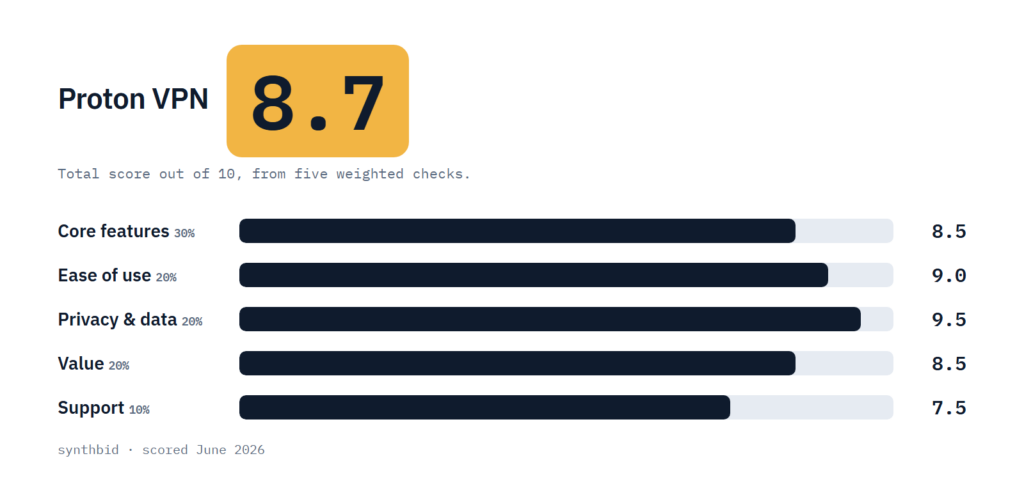
Core features, 8.5. Secure Core, Tor over VPN, port forwarding, Profiles, Stealth and a network of 20,000+ servers are a long list for a single paid plan, and every feature is included from the first day. I stopped short of a higher score because of the latency, NetShield’s weak showing against malware and phishing sites, the lack of post-quantum encryption, and OpenVPN no longer being native on Mac, Android and iOS.
Ease of use, 9.0. The apps look and work alike on every platform, quick connect gets a first-time user online in a tap, Smart Protocol Selection removes the protocol choice and settings carry plain explanations. Reviewers’ notes on the Mac kill switch wording and the browser extension keep it from a perfect score.
Privacy and data, 9.5. Swiss jurisdiction, open-source apps, repeated no-logs audits and a record of denying requests are among the strongest sets of evidence in this category. I did not give it a full mark because of the Proton Mail disclosures, the choice not to use RAM-only servers and the open question on Swiss surveillance law.
Value, 8.5. A free plan without a data cap and a Plus price of $3.49 a month, with every feature and 10 devices, make it good value. I took points off because the monthly rate roughly doubles at renewal.
Support, 7.5. The help library is deep and paid users get live chat that reviewers reached quickly. Free users have email only, one review found no round-the-clock chat, and a follow-up ticket reply slowed to hours, so I rate it good but not strong.
The total, weighted as described on the How I test page, comes to 8.7.
Alternatives worth a look
NordVPN
Choose it when speed, streaming and a long feature list matter more than a privacy record, and you will manage the renewal date. The NordVPN review has the numbers.
Mullvad
Choose it when you want one flat price and the least personal data at signup, and you can live with weaker streaming. The Mullvad review explains the trade.
ExpressVPN
Choose it when polished apps and RAM-only servers count for more than price. The ExpressVPN review covers its renewal.
FAQ
Is Proton VPN trustworthy?
The evidence is strong: Swiss law, open-source apps, a run of independent no-logs audits and a transparency report that lists denied requests. The incidents people cite involve Proton Mail and not the VPN, though they show that account and payment data can still be requested.
What are the downsides of using Proton VPN?
The main ones are latency in published tests, a free plan limited to 1 device, and a monthly rate that roughly doubles at renewal. Native OpenVPN is also limited to Windows, per the newer review, and live chat is for paying users.
Is it worth getting Proton VPN?
I think so if privacy is your priority, because Plus bundles every feature with 10 devices at $3.49 a month on the 24-month plan. Try the free plan first, and buy a long term on purpose, with a reminder set before it renews.
Is the Proton VPN free plan really free?
Yes. Proton’s page shows $0.00 a month and no credit card requirement, and the free-plan page says paying users fund it. The limits are 1 device, medium speed, 10 countries chosen for you and no streaming or P2P.