Bottom line
- Incogni sends opt-out requests to more than 420 data brokers for you and keeps repeating them for as long as you subscribe.
- Deloitte reviewed its coverage claims and its statement that it does not sell data, an audit that PCMag says no other removal service it has covered can point to.
- Standard costs $7.99 a month on an annual plan and doubles on monthly billing, and custom removals need the pricier Unlimited plan.
What works
- Automated requests to 420+ data brokers, repeated for as long as you subscribe
- A dashboard that lists each request with its status and average time to resolution
- An outside assessment by Deloitte of its coverage and no-sale claims
- A 30-day money-back guarantee on every plan
What doesn’t
- No free plan or trial
- Removals are verified on public people-search sites but not on private brokers
- Custom removals need the Unlimited plan at $179.88 a year
- It may ask you to confirm profiles that belong to other people
What Incogni does
Incogni is a data removal service. You give it your details, and it contacts data brokers and people-search sites on your behalf and asks them to delete what they hold on you. Its pricing page says the automated removals cover 420+ data brokers, and the service sends repeat waves of requests so that profiles do not simply reappear.
Incogni was built by Surfshark, the VPN company, and now runs as a standalone product. Surfshark’s own pricing page still lists data removal by Incogni inside some of its plans, so you may meet it as an add-on to a VPN subscription.
What you hand over
Setup asks for your full name, home address and date of birth. You then sign an online authorization that lets Incogni make removal requests in your name, a very limited power of attorney. You can add up to three addresses, three email addresses and three phone numbers. I would fill every slot, since brokers match records on those details.
That is a lot of personal data to give to a company whose job is to reduce your exposure, so the privacy policy matters. It says Incogni does not sell your personal information and has not done so in the past, and that it keeps a copy of your authorization and the details in it. PCWorld reports that customer data is kept for a maximum of 12 months after you cancel. The policy also says Incogni shares data with other Surfshark group companies for administrative purposes.
Incogni says Deloitte independently assessed its practices, and the audit is dated August 2025. That is a point in its favor, and PCMag says Incogni is the only personal data removal service it had seen go through a third-party audit. An audit confirms what was checked, though, and it does not tell you how any single removal went.
How the removal process works
After sign-up, Incogni scans people-search sites for your details and sends a removal request when it finds a match. Private data brokers cannot be searched, so it sends requests to the ones likely to hold your data. It follows up every 60 to 90 days for as long as you subscribe, and it also asks brokers to add you to suppression lists so they stop collecting your data again.
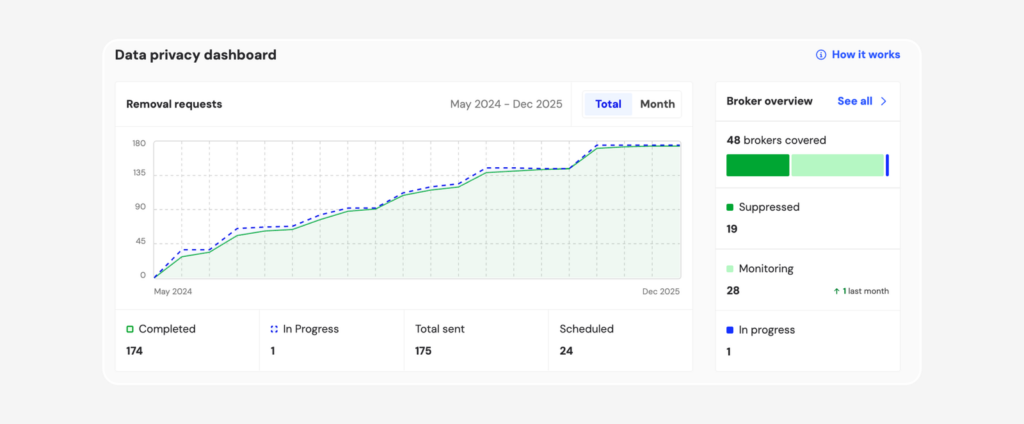
Brokers get 30 to 45 days to answer a request, so a new account will not show a finished job in the first week. One reviewer who followed the dashboard counted 743 requests sent and 662 completed a month in.
Where to be careful
The dashboard lists every request with a status, a request ID and an average time to resolution, and a resolution time shown in red marks a broker that has proven resistant. The thing to watch is what Completed means. One review explains that Completed covers brokers that removed your data and brokers that replied they never had it, so a high completed count does not mean that many profiles were found and deleted.
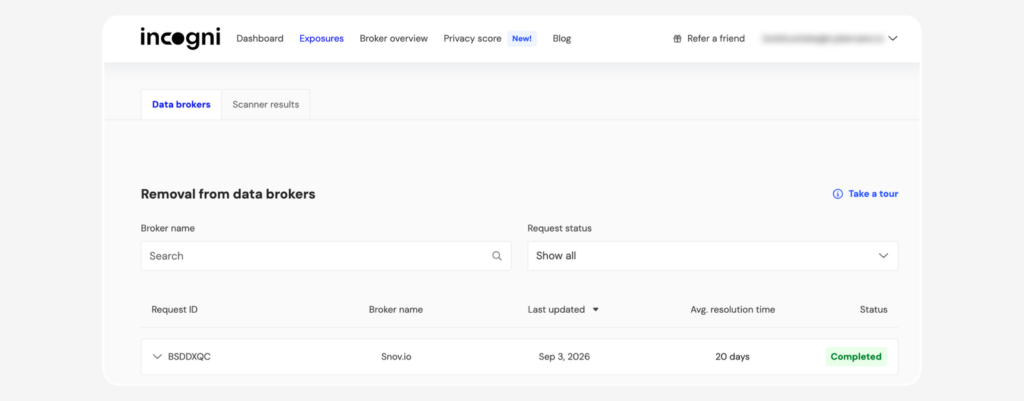
Incogni verifies removals on public people-search sites but not on private brokers, where a request is marked completed once the broker confirms. One reviewer spot-checked several public sites and found them clean except Spokeo, which still showed a profile behind its paywall while a new request was already pending.
Record matching is the smaller annoyance. Several reviewers describe being asked to confirm candidate profiles, and some of the candidates were clearly not them. Incogni says many people-search sites return unrelated results, so it asks users to confirm which profile is a real match.
Custom removals
The Unlimited plan adds custom removals. You paste the address of a page that shows your data, and an Incogni specialist reviews it and either removes the data or explains why not. Incogni says the feature covers 3,000+ additional sites. Some data, such as court records, government records and social media accounts, is not suited to removal, and none of these services guarantee that custom requests succeed.
Pricing
| Plan | Price | Billed | What you get |
|---|---|---|---|
| Standard | $7.99/mo | $95.88 a year | 420+ brokers, repeat removals, multiple emails, addresses and phone numbers |
| Unlimited | $14.99/mo | $179.88 a year | Standard plus custom removals on 3,000+ sites and live phone support |
| Family | $15.99/mo | $191.88 a year | Standard for up to 5 members |
| Family Unlimited | $22.99/mo | $275.88 a year | Unlimited for up to 5 members |
| Protect (US only) | $20.74/mo | $248.88 a year | Unlimited plus identity-theft insurance and credit monitoring |
Prices from Incogni’s pricing page, checked July 2026.
Standard is the plan most people need. Unlimited is worth it only if you expect to find your data on sites outside the 420. Monthly billing doubles the Standard price to $15.98, so the annual plan is the one to look at, and the 30-day money-back guarantee covers every plan.
Incogni runs frequent promotions, and when I checked, its home page advertised 55% off annual plans, so the checkout price may be lower than the table. For comparison, DeleteMe is listed at $129 a year for one person and Optery’s entry tier at $39 a year, with fewer brokers covered.
How it scored
Core features, 8.5. It automates 420+ brokers, repeats requests, asks for suppression and adds custom removals on the higher plan. I took points off because removals on private brokers cannot be verified and the Standard plan has no way to add a site outside the list.
Ease of use, 8.0. Setup is a short form and a signature, and the dashboard is clear about what has been sent. The prompts to confirm profiles are the main friction.
Privacy and data, 8.5. The service asks for a lot, but the policy says it does not sell data, retention after cancellation is limited, and Deloitte reviewed its claims. Sharing administrative data inside the Surfshark group keeps this from a higher score.
Value, 7.5. Annual billing at $7.99 a month is a fair price for 420+ brokers, but monthly billing doubles it and Optery’s entry tier costs less per year.
Support, 7.5. Incogni lists 24/7 live chat on every plan and live phone support on Unlimited. That is solid on paper, and it carries the smallest weight in the total.
The weights and the method are on the How I test page.
Alternatives worth a look
Optery
Pick it if you want a free report first and before-and-after screenshots that show a removal worked. The Core tier is $39 a year.
DeleteMe
Pick it if you want a long-established service, with periodic reports on what was removed. It is listed at $129 a year for one person.
Privacy Bee
Pick it if you want the widest automated coverage. It automates opt-outs for over 1,000 sites at $197 a year.
FAQ
Does Incogni work?
For the automated part, the published tests say yes. One reviewer counted 662 completed requests a month in. Completed includes brokers that said they held nothing, so the count overstates how much data was found and deleted.
Does Incogni have a free trial?
No. Reviewers consistently report that there is no free plan or trial. Incogni does offer a free exposure scan, and every plan has a 30-day money-back guarantee.
Which countries does Incogni cover?
Its pricing page says plans are supported in the US, UK, EU, Ireland, Canada, Isle of Man, Switzerland, Norway, Iceland and Liechtenstein, and that the Protect plan is US only.
Who owns Incogni?
Incogni was built by Surfshark and now operates as a standalone product. Its privacy policy names Surfshark group companies among the recipients of administrative data.