Bottom line
- Aura puts three-bureau credit monitoring, fraud restoration and up to $1 million of identity theft insurance per adult into one subscription, which is why I would shortlist it ahead of services that only send alerts.
- The security extras are the weaker half: the antivirus has no published independent lab scores and the VPN has no kill switch, so I would treat them as a bonus and not a reason to buy.
- Signing up means handing over your Social Security number, and a phishing attack on an employee, disclosed in March 2026, led to unauthorized access to 900,000 records, so I would turn on two-factor authentication on day one.
Aura is an identity theft protection service with a broader security bundle attached. It suits people who want one subscription for credit monitoring, fraud help and a few device tools, and who accept that the extras are not best in class. The trade-off is that one company ends up holding your Social Security number, bank links and documents, and the price climbs quickly once a second adult or a family is involved.
What works
- Monitoring at all three credit bureaus on the Individual, Couple and Family plans
- $1 million of identity theft insurance for every adult, paid as reimbursement against proof of loss
- A fraud restoration team reachable by phone at any hour
- A Couple plan, and a Family plan for five adults and unlimited children
What doesn’t
- Family is expensive, at $50 a month when billed monthly
- No social media, USPS address change, medical data or utility alerts
- The antivirus has no published independent lab scores and the VPN has no kill switch
- A phishing attack on an employee exposed 900,000 records in March 2026
What Aura is and what it is not
Aura sells monitoring for your identity and your credit, then wraps a password manager, VPN, antivirus and data removal around it. One review lists four plans, Individual, Couple, Family and Kids, and explains that the price depends mostly on how many people are covered and not on which services you pick. That means even the base plan gets most of the suite.
Monitoring is not prevention. Aura’s own fine print says no one can prevent all identity theft or monitor all transactions effectively, and a review of the transaction tool notes that it sends notifications and does not block anything. I read that as the honest framing: you are paying for early warning, a restoration team and an insurance policy for the aftermath.
Credit and identity monitoring
Credit monitoring covers Experian, TransUnion and Equifax, with alerts for new accounts and credit inquiries. The credit lock is where the sources differ. Aura’s home page promises an instant lock on your Experian file, one review says Aura only guides you through freezing TransUnion and Equifax, and another says you can freeze at all three bureaus from the Credit section. I would assume the instant lock covers Experian alone and plan to freeze the other two yourself.
Beyond credit, Aura alerts you if your Social Security number, online accounts or home and auto titles turn up somewhere they should not, and it scans the dark web for exposed emails and passwords. Title monitoring draws on public records for properties you have owned in the last 20 years, but loans taken out after you sold a property are not visible, so treat it as a partial view.
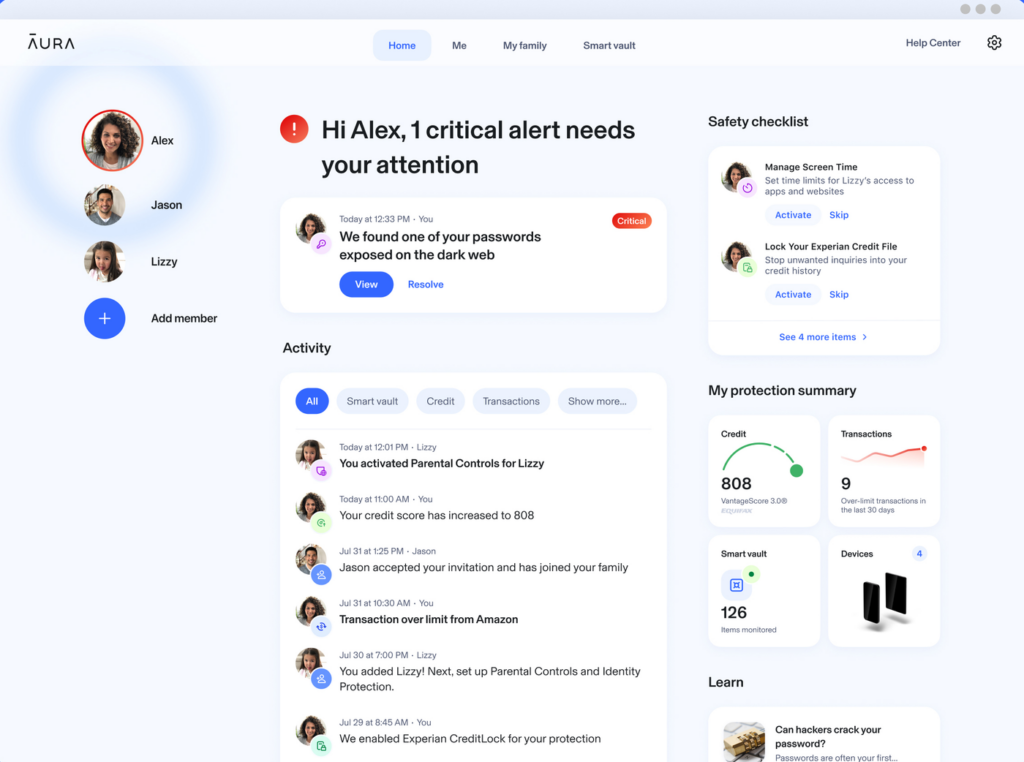
To watch bank and retirement accounts you link them through Plaid, a fintech connection service, and set the amount that triggers an alert. Aura also asks data brokers and people-search sites to remove your details and repeats the request if they reappear. In one review the dashboard reported removals from 12 sites after a day, which tells you what was found and not how complete the job is. If removal is your main reason for looking, my Incogni review and my step-by-step guide to doing it yourself shows what a dedicated service or a manual pass involves.
Insurance and fraud restoration
Every adult on a plan is covered up to $1 million, so the Couple plan carries $2 million between two people and Family carries $5 million across five adults. It is a reimbursement policy and not a payout. You claim documented costs such as lost wages, stolen funds and fees for accountants or investigators, and Aura does not hand over a lump sum.
The policy is written by an outside insurer, and Aura’s page tells you to read the actual policy for terms, conditions and exclusions, with a warning that coverage may not be available in every jurisdiction. Children are the notable gap. The Kids plan has no insurance, and child members on the Family plan get only online account and Social Security number monitoring.
Reviewers also list what Aura does not offer: social media monitoring, USPS address change alerts, medical data reports and utility alerts. The same review names LifeLock by Norton as the service that has social media and USPS alerts and may offer more insurance, so that is the comparison I would run if those gaps matter to you.
If something does go wrong, a U.S. based restoration team is on call around the clock, builds a plan for your case and can act as go-between with a bank or lender. Recovery can take anywhere from a few weeks to several months, which is the expectation I would set, and you should also report the fraud to the FTC at IdentityTheft.gov.
The security extras
The antivirus runs quick, full and custom scans, with no scheduling and no logs. The antivirus has no published independent lab scores, and in a prepared malware test the reviewer rated its performance as mediocre next to established products. On a Mac it lacks real-time protection, iPhones get no antivirus at all, and the Android app has no anti-theft tools.
The VPN is an on and off switch. TechRadar reports that it connects to the fastest nearby U.S. server, with no manual server choice, no split tunneling and no kill switch, and measured a slowdown of 2 to 5% depending on the time of day. Aura’s home page advertises 100+ virtual locations, which does not fit a no-choice description, so check what the app offers on your platform before relying on it. I would not buy Aura for streaming or P2P, and the same review says it is not the best choice for either.
The password manager uses your Aura password as its master password, so one login protects both, and it cannot sort entries into folders or tags. That is fine for basics. If passwords matter more to you than the rest of the bundle, my Bitwarden review covers a dedicated option. The Family and Kids plans add parental controls and voice and text monitoring for over 200 PC games, which is the extra that stands out most in one review.
What you hand over
Sign-up asks for your full name, home address, phone number, date of birth and Social Security number, and then a card or PayPal. Linking accounts, saving passwords and uploading documents to the vault puts a lot of sensitive material in one place. That is the point of the service and also its risk.
Aura says it never sells your data to third parties, and one review adds that revenue comes from subscriptions and personal information is not used for third-party advertising. The same review says Aura collects device, browser and usage data, and that as a U.S. company it can be required to hand data over when a court approves.
The March 2026 incident is the fact I weigh most. A phishing attack on one employee led to unauthorized access to 900,000 records, mostly names and email addresses. TechRadar says no Social Security numbers or financial data were involved, that Aura contacted the people affected, and that the exposure could leave existing customers open to follow-up phishing. Only one of the sources I read reports the incident, so read Aura’s own statement before you rely on the details.
Aura offers two-factor authentication, prompts you to set it up at sign-up, and logs you out after a short period of inactivity. Its optional account cleanup tool scans up to five Gmail or Outlook inboxes for old accounts, which is another sensitive permission to weigh. I would switch on two-factor authentication, use a password you use nowhere else, and treat any message about your Aura account with suspicion, which is also what Aura’s own security notice advises.
Support and cancelling
Aura lists 24/7 support on its home page, and one review reports 24/7 phone support, email and chat. Phone is the channel to count on: one reviewer found agents knowledgeable and reports no long waits. Chat is weaker, since one review says it runs only on weekday business hours and another says a chatbot handles it outside US working hours.
You cancel online from the Membership page behind the gear icon. One reviewer hit a site glitch and had to phone support to finish the cancellation, and the other notes reports of charges continuing after cancellation, which it could not verify. Keep the confirmation email and watch your card statement for a cycle. One review adds that marketing email may pick up after you leave.
Pricing
| Plan | Monthly billing | Annual billing | Devices | Insurance |
|---|---|---|---|---|
| Individual | $15 | $144 a year ($12 a month) | 10 devices | $1 million |
| Couple | $29 | $264 a year ($22 a month) | 20 devices | $2 million |
| Family | $50 | $384 a year ($32 a month) | Unlimited | $5 million |
| Kids | $13 | $120 a year ($10 a month) | Unlimited | None |
Prices from Aura’s plans page, checked September 2026. Annual totals are twelve times the monthly rate shown there.
Annual billing is where the savings are. Twelve months of Individual at $15 comes to $180, against $144 on the annual plan, so paying yearly saves $36. On Family, twelve months at $50 comes to $600 against $384, a saving of $216.
Aura’s home page says plans start at $10 a month. That is the annual price one review gives for the Kids plan, the one without credit monitoring or insurance, so the realistic starting point for an adult is $12 a month on Individual billed yearly. One review’s table also shows lower figures labelled as its own pricing, $9, $17 and $25 a month for the three adult plans, which I could not match to Aura’s pages, so I use the figures both reviews share.
Each plan comes with a 14-day free trial, but you enter payment details at sign-up and Aura charges you automatically when the trial ends unless you cancel first. The home page adds that the trial can be redeemed once per customer and that full access depends on identity verification and credit eligibility. The 60-day money-back guarantee is where the sources differ: one review states it without conditions, while the home page limits it to annual plans bought through Aura’s websites or its support team, and counts the 60 days from the day your trial began.
For context, CNET puts LifeLock by Norton at $23 a month for credit lock access, a monthly credit score and bank fraud alerts, and says ID Shield charges $20 a month for three-bureau monitoring. A second review calls the family plan above the industry average and points to Identity Guard as a leaner, cheaper family option. If budget is the constraint, That review suggests Zander at $7 a month. I would price Aura against those before paying for a year.
How it scored
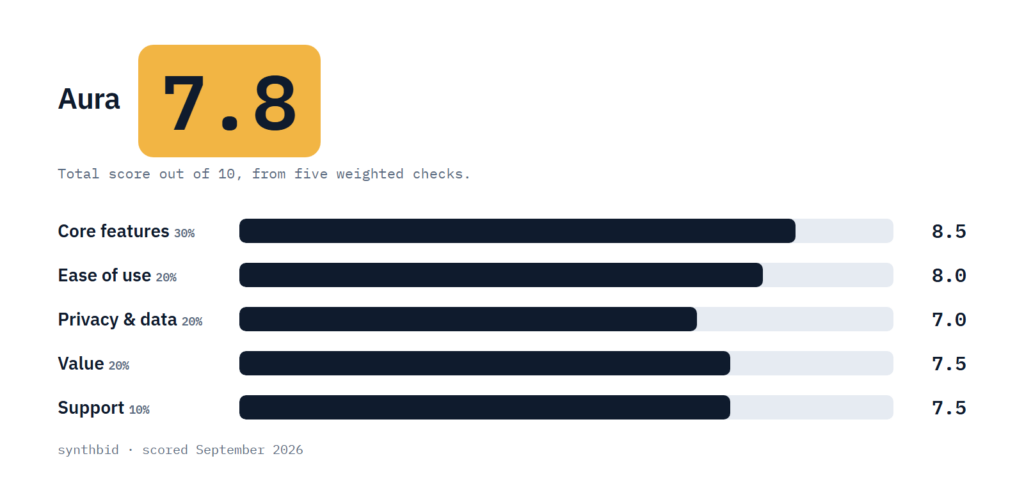
Core features, 8.5. Three-bureau credit monitoring, restoration, insurance, data removal and a family tier in one subscription is a wide feature set. I held it below 9.0 because the instant credit lock covers Experian alone, several alert types are missing, and the antivirus and VPN are thin.
Ease of use, 8.0. Both reviewers found the interface clear, and one compared it to tax software. The Mac antivirus is weaker than the Windows one, and one reviewer needed a phone call to finish a cancellation.
Privacy and data, 7.0. Aura says it does not sell data and offers two-factor authentication, but it holds your Social Security number, bank links and documents, and the March 2026 incident exposed 900,000 records. The home page claims certified data security and privacy without naming the certification, which is not enough to lift the score.
Value, 7.5. The annual price for one person is fair for a bundle that includes insurance and restoration, and a Couple tier is unusual. Both reviews say the Family plan costs more than most rivals, month-to-month billing is dear, and the extras are not strong enough to justify a premium on their own.
Support, 7.5. Round-the-clock phone support and a restoration team are the strongest part of the service. Limited chat hours and the cancellation complaints keep it from going higher.
Each check carries a different weight, which the How I test page spells out. For Aura, the weighted total comes to 7.8.
Alternatives worth a look
Incogni
Pick it if data removal is the part you want and the rest of the bundle is noise. My Incogni review covers what it does and where it falls short.
Malwarebytes
Pick it if you would rather have a dedicated antivirus than Aura’s bundled one. My Malwarebytes review covers the free and premium versions.
NordVPN
Pick it if streaming or P2P matter, since Aura’s VPN is not built for either. My NordVPN review covers the speed and the pricey renewal.
FAQ
Is Aura really worth it?
Yes, if you would otherwise buy credit monitoring, a restoration service and some device tools separately, because Aura bundles them for one price. It is harder to justify if you only want the VPN or antivirus, or if money is tight, since cheaper monitoring services exist. Both reviews I read call the value good, and both say the Family plan costs more than most rivals.
What is the downside of Aura?
The price on monthly billing, an instant credit lock that covers Experian only, missing social media, USPS, medical and utility alerts, thin antivirus and VPN tools, and the amount of sensitive data you hand over. The March 2026 incident is also a fair reason to pause before signing up.
Is it safe to give my SSN to Aura?
Aura needs it to monitor your credit and identity, and says it never sells data to third parties. Safe is relative: the company was hit by a phishing attack in March 2026 that, according to one review, did not involve Social Security numbers or financial data. If you go ahead, turn on two-factor authentication, use a unique password and link only the accounts you want watched. If that is more exposure than you want, skip it.
Does Aura have a free trial?
Yes, a 14-day free trial on each plan, but you give payment details at sign-up and are billed once it ends unless you cancel. The trial can be redeemed once per customer.