Bottom line
- Optery suits people who want proof that each removal happened, and its free plan lets you see where your details appear before you pay.
- In a published lab comparison its top paid plan came out best, but opt-outs done by hand still did better, so I would pay for coverage only if you will not do the work yourself.
- The top plan is priced far above the entry plan, so I would start on the free plan or Core and move up only if you can name what the extra money buys.
Optery is a data removal service. It looks for your details on data broker and people-search sites, then files opt-out requests with the ones that list you. It sits in a useful middle position: a free plan you can open without a card, cheap automated plans below it, and a top plan for people with a serious privacy need. The real question is which tier an ordinary buyer should land on.
What works
- A free plan with an exposure report and self-service removal tools, and no credit card needed
- Before and after screenshots for each removal, plus an activity history
- The strongest result in a published lab comparison of removal services
- Support for state-run address confidentiality programs
What doesn’t
- The top plan is expensive, and its custom removals ask for a link and a screenshot
- Core covers one name only, and full coverage needs Expanded Reach, which shares your details more widely
- Site counts differ between sources and may be inflated by duplicate listings
- Support is mostly email, and reviews disagree about live chat
What Optery is and what is free
The company is headquartered in the United States, and its main selling point is evidence. A screenshot is taken when your details are found and another after they are removed, and reviewers single that out as the feature that sets it apart from services that only report a status. TechRadar also stresses the transparency of the reporting.
The free plan deserves a closer look before you spend anything. Free Basic needs no credit card. It gives you a personalized exposure report with screenshots, a scan of your Google and Bing results, and self-service removal tools, and you do the opting out yourself. Few removal services offer a free tier at all, and one review notes that a rival with a free plan offers it only as a mobile app. If you would rather do the whole job by hand, the manual route is laid out in my step-by-step opt-out guide.
What the paid plans include
There are three paid tiers, and each one includes everything in the tier below it. Core is fully automated: it removes you from 380+ sites, or 150+ if you leave Expanded Reach switched off, with monthly scans. It allows one name and one city and state per person, and no human privacy agent is assigned. That single-name limit is why I would steer anyone who has changed names, or who appears under variations, to a higher tier.
Extended adds people to the machines. It covers 560+ sites (330+ without Expanded Reach), allows unlimited name variations and past addresses, and assigns a human privacy agent for special circumstances. It also sends removal reports with before and after screenshots about every 90 days and includes a tool to blur your home on Google Maps and Apple Maps.
The top paid plan covers 635+ sites (405+ without Expanded Reach). It adds unlimited custom removal requests, which take the total to 950+ sites after a 30-day wait, a tool for submitting outdated content to Google, Bing, DuckDuckGo and Yahoo, and priority email support.
Expanded Reach is the setting to understand before you pay. It sends your details to brokers that Optery says do not usually post or sell information publicly, so the wider coverage comes from sending your data to places that may not hold it. One review puts the extra at about 230 sites, and the pricing page numbers agree, because 380 minus 150 is 230. You can leave it off, but then the headline coverage you paid for shrinks.
Site counts differ between sources, so I would treat the pricing page as the current figure and the reviews as a range. One review gives up to 360, 535 and 635 sites for the three paid tiers, while another gives 80 to 100, 200+ and 300 to 600+. Counting rules differ, and a service can count one site network several times.
Does it work?
The best evidence I found is a lab comparison that CNET reports from Consumer Reports. After four months, the top paid plan had removed 68% of listings, the best result among the services in the test, and its success rate was 52% within a week and 58% at one month.
That is a good result with a catch. Opting out by hand had a 70% success rate at all three checks, so even the strongest paid service did not beat careful manual work. The cheapest rival in the same review, EasyOptOuts at $20 a year, did better than Optery at one week and one month and fell behind only at four months. The gap between $249 and $20 is $229 a year, which is why I treat the price of the top plan as the main question and not its quality.
Site counts deserve some suspicion as well. The reviewer found court-record sites in two states that looked separate but led to one network, and niche listings that most people will never appear on, such as a directory of California dentists. A bigger number on the plan page does not always mean more of your data is gone, so I would judge the service by what it removes for your own listings.
Setup, the dashboard and custom removals
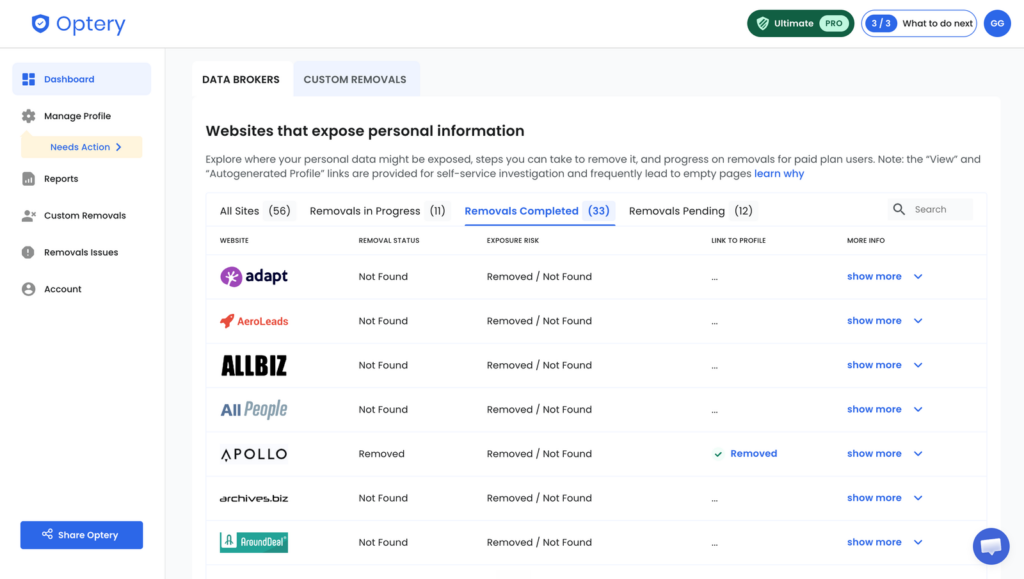
Setup asks for your name, an email address and at least one address, and the account form also asks for a date of birth. The CNET reviewer could enter one name and address at first and add more afterward, and saw the first scan results in the dashboard about an hour later. The dashboard shows one graph of how exposed you are and another of removal progress, with screenshots of each listing marked Removed, Pending or similar.
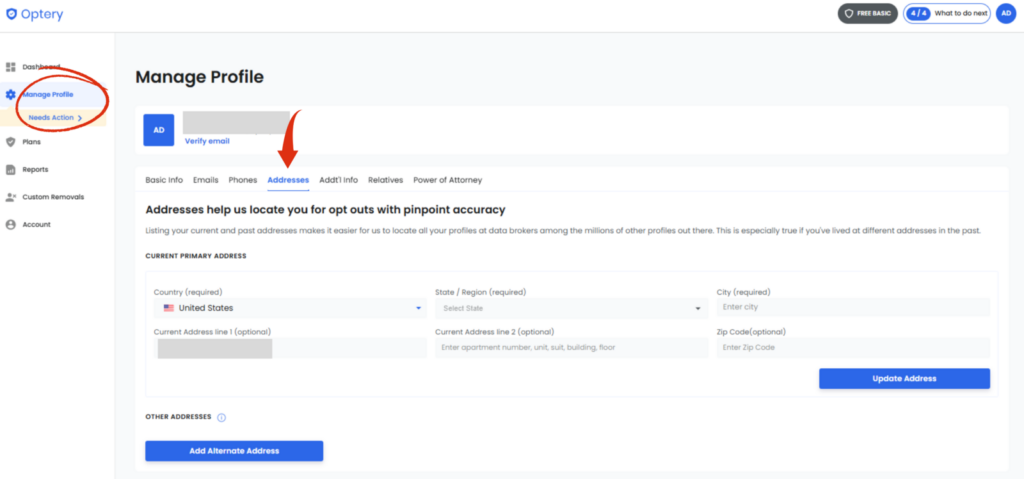
The same reviewer found the dashboard more informative than the periodic reports, and called its dashboard one of the most transparent and easy to follow. The pricing page ties the before and after reports to Extended and above. I like that you can check a listing yourself instead of trusting a status label.
Custom removals are the weak point. Optery asks for a link to the page and a screenshot of your information on it, where rivals such as Incogni and Kanary ask only for a link. For the price of the top plan I would expect that routine task to be easier, and the reviewer says the same. The second review adds that the depth of reporting and settings can feel dense if you want a fully hands-off service.
One feature I would not skip over is support for state-run Address Confidentiality and safety programs. If you are enrolled in one, a Safety Program tab asks for your ID and some details, and Optery can then notify data brokers of your rights. It is rare in this category, and the review points out that another service offers something similar only on its most expensive tier.
Privacy and trust
A removal service holds a profile of you, so its own handling matters. Optery lists SOC 2 Type 2 compliance on its pricing page, and the reviewer confirms it undergoes security audits, although individuals cannot read the results. The same is true of DeleteMe, so I count it as normal for the category and not as a mark against Optery.
On retention, the company told the reviewer that it deletes personal data immediately when you delete your account. The review sets that beside rivals: DeleteMe keeps information for up to six months after deletion, and Incogni may hold some for up to 24 months. I would put that in Optery’s favor, since a shorter tail means less of your profile sitting in someone else’s system.
Two details cut the other way. The privacy policy says Optery takes part in retargeted advertising, which California law may treat as sharing data, although the company told the reviewer it does not sell or share your data, and a Your Privacy Choices toggle turns the advertising off. And Expanded Reach, described above, sends your details to sites that may not already hold them, with the risk that one of them leaks the data in a breach.
Optery can also act for you under a limited power of attorney that you switch on from the dashboard and can revoke at any time. Some brokers reject opt-outs filed by a third party, and this is how the service gets around that. The policy promises 30 days’ notice by email and time to delete your account if the company merges or is acquired.
Support
The sources split here. One review describes live chat and email support alongside a help desk with clear categories such as Data Broker Coverage and Billing and Payment, and reports that the chatbot answered a question about how many names an account holds in about an hour, after warning that replies can take up to 24 hours. The other review says there is no live chat or phone and that help comes through email and the help center.
The pricing page lists only email support, standard on the free plan and priority on the top paid plan, so I would plan on email and treat chat as a bonus. Where Optery is strong is self-service: the help desk answers questions on topics such as blurring your house online and privacy laws, and step-by-step videos show how to remove yourself from individual brokers, which is useful even if you stay on the free plan.
Pricing
| Plan | Monthly billing | Yearly billing | Best for |
|---|---|---|---|
| Free Basic | Free | Free | Seeing your exposure and opting out by hand |
| Core | $3.99/mo | $39 a year | One name and a small budget |
| Extended | $14.99/mo | $149 a year | Several names and a human agent |
| Top paid plan | $24.99/mo | $249 a year | Maximum coverage and custom removals |
Prices from Optery’s pricing page and two published reviews, checked July 2026.
The pricing page shows monthly prices and offers a yearly switch that it says saves 17%. The yearly prices in the table come from the two reviews, which agree on $149 and $249 for the upper two tiers. For Core, one review writes $40 in its text and $39 in its table, so I use $39 and would confirm it at checkout.
Billing terms are mild. Individual accounts get a 30-day money-back guarantee, and the page says you can cancel any time. The saved page gives no renewal price, so I would mark the renewal date and read the price at checkout before it comes round. One timing detail is worth a question to support: the page says custom removals become available after 30 days, and the guarantee also runs for 30 days, so if custom removals are the reason you pick the top plan, ask how the two dates line up before you rely on a refund.
Brokers repopulate profiles over time, and the same review recommends keeping a subscription active for that reason. Treat the price as an ongoing cost, not a one-time cleanup.
How it scored
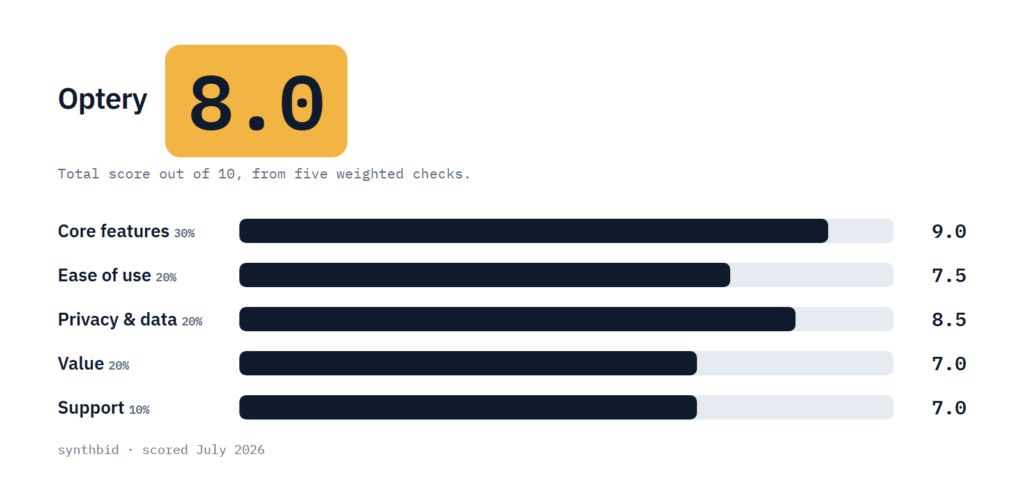
Core features, 9.0. Wide coverage on the pricing page, human agents from Extended upward, before and after proof for every removal, a free plan, tools for outdated search results and the best result in the published lab comparison. I held it below 9.5 because hand opt-outs still did better in that test, custom removals are cumbersome and the site counts are inflated by duplicates.
Ease of use, 7.5. The dashboard is clear and the first scan comes back quickly, but custom removals ask for extra proof, Core allows one name, and choosing a tier means deciding about Expanded Reach. One review also calls the depth of settings dense.
Privacy and data, 8.5. Audit certification, immediate deletion when you close the account, a stated policy of not selling data and a revocable power of attorney are strong points. I took points off for the retargeted advertising in the privacy policy, the wider sharing that Expanded Reach requires and audit results that customers cannot read.
Value, 7.0. The free plan and low-priced Core plan are good value, and the 30-day guarantee limits the risk. The top plan costs far more than a rival that did better over the first month, and the renewal price is not on the page I saved.
Support, 7.0. The help desk and videos are strong and email is on every plan. Reviews disagree on live chat, there is no phone line, and priority handling is reserved for the top plan.
How I test explains the weights, and Optery totals 8.0.
Alternatives worth a look
DeleteMe
Pick it if you want specialists to work through brokers by hand and are happy to prepay a year. The details are in my DeleteMe review.
Incogni
Pick it for a fully automated service with a simple setup. I cover the trade-offs in my Incogni review.
Do it yourself
Pick it if only a few sites list you. Optery’s free plan can serve as the scanner while you do the opt-outs.
FAQ
Does Optery really work?
Mostly yes, with limits. In the lab tests one review cites, the top paid plan cleared 68% of listings after four months, the best result tested, but opt-outs done by hand reached 70%. The screenshots let you confirm what was removed.
How much does Optery cost per month?
The pricing page lists $3.99 for Core, $14.99 for Extended and $24.99 for the top paid plan on monthly billing, and the free plan costs nothing. Yearly billing is cheaper, and the reviews list $39, $149 and $249 per year for the three paid tiers.
Which is better, DeleteMe or Optery?
On my scores they are close: Optery 8.0 against 7.9 for DeleteMe. Optery has a free plan and a monthly option, while DeleteMe has no free plan and bills yearly, and puts specialists on every plan. One review lists Optery’s paid plans at $39 to $249 a year and DeleteMe’s at $129 to $500. My DeleteMe review has the full picture.
Does Optery have a free plan?
Yes. Free Basic needs no credit card and includes an exposure report, a scan of Google and Bing results and self-service removal tools. You do the opt-outs yourself, and the paid plans add automation.