Bottom line
- Proton VPN ranks first on my checklist, but the streaming roundup I read puts ExpressVPN first and NordVPN second, so the order depends on how much weight you give privacy and renewal prices.
- Streaming access shifts often, so I would use the 30-day refund window to check your own service before you commit to a long plan.
- Surfshark and IPVanish put no cap on devices, and NordVPN was the fastest in that roundup’s speed tests.
I scored five VPNs with the same five checks as in my main VPN ranking: what the product does, how easy it is to live with, how it treats your data, what it costs to keep and how good the support is, weighted 30, 20, 20, 20 and 10. For this page I read each entry through a streaming lens: what the reports say it unblocks, how fast it ran where a test figure exists, how many devices it allows and what it costs to keep. The sources are a streaming roundup from CNET, an explainer from PCMag on how streaming services spot VPNs, and each company’s pricing page.
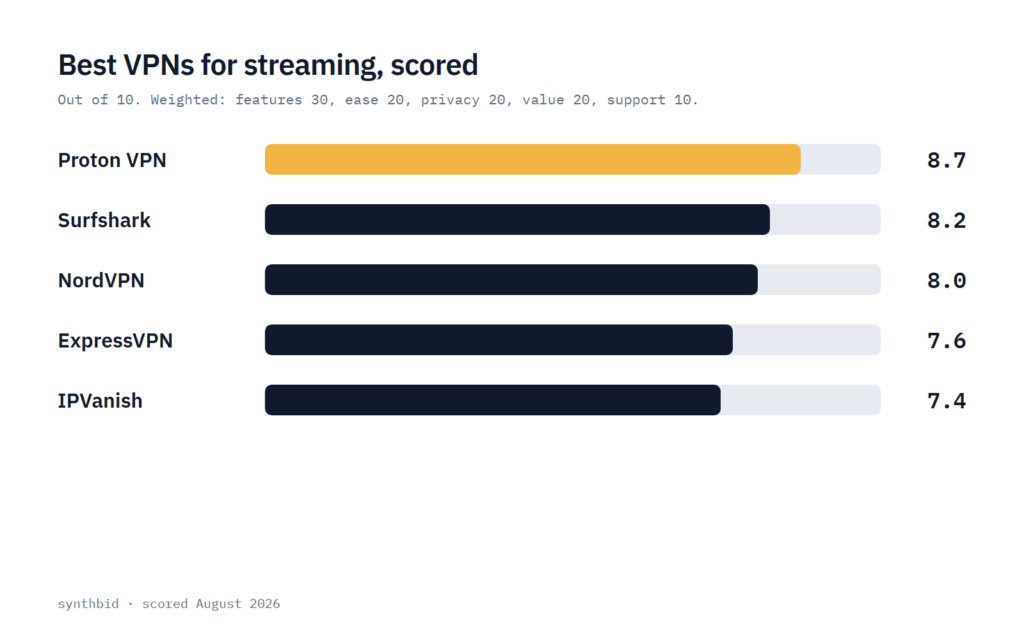
The order below follows my total score. That total counts privacy and the renewal price, so it differs from the order in the roundup. I note the differences as I go.
The ranking at a glance
| VPN | Score | Price | Best for |
|---|---|---|---|
| 1. Proton VPN | 8.7 | from $3.49/mo | A free plan to try first, with streaming on paid plans |
| 2. Surfshark | 8.2 | from $2.49/mo | Unlimited devices on a tight budget |
| 3. NordVPN | 8.0 | from $3.49/mo | Speed, if you watch the renewal |
| 4. ExpressVPN | 7.6 | from $2.99/mo | Routers and TVs, at a premium price |
| 5. IPVanish | 7.4 | from $2.39/mo | Unlimited devices and a choice of servers |
Prices are the introductory long-plan prices on each company’s pricing page, checked August 2026. The Pricing section below shows what each plan renews at.
Proton VPN: top of my list
Proton VPN comes first because a strong privacy position and a plan you can start without paying for are rare together. Proton’s pricing page lists streaming under the paid plans, and Plus covers 10 devices across more than 20,000 servers in over 140 countries.
On streaming itself the roundup is positive. It calls Proton VPN the most versatile of its four picks and says it unblocks Netflix, Disney Plus, Hulu and Amazon Prime Video, with a vast network of server locations. It also lists trouble with Disney Plus on macOS and no 24/7 live chat.
The free plan needs no credit card, but it covers 1 device, servers in 10 countries picked for you at random, and medium speed. Proton’s page does not list streaming under Free, while the roundup calls the free plan decent for streaming. I would use free as a way to try the app, not as the plan to count on for one particular service.
Plus works out at $3.49 a month on a two-year term, that is $83.76 up front for the first 24 months, then $83.88 for each following year, with a 30-day money-back guarantee.
Why 8.7. Core features earn 8.5 for the streaming results and the server network, held back by the macOS problem the roundup reports. Ease of use is 9.0 because you can try it without a card. Privacy is 9.5, the same figure as in my main ranking, helped by open-source apps and a Swiss base. Value is 8.5 for the lowest renewal figure on this page. Support is 7.5 because the roundup reports no round-the-clock live chat.
Scores: core 8.5, ease 9.0, privacy 9.5, value 8.5, support 7.5. Total 8.7.
Surfshark: unlimited devices on a budget
Surfshark puts no limit on simultaneous connections, so one account can cover every phone, laptop and TV in a household. Its pricing page lists apps for Android TV, Apple TV and Fire TV, and a network of 4500+ servers in 100 countries.
The roundup names it the best value pick and says its speeds are excellent for 4K. It also points to an Android GPS spoofer that may help with services that check your location, such as YouTube TV.
It warns about two things: long-plan prices that more than double at renewal, and trouble streaming Hulu on certain platforms. It lists the renewal at $99 a year, a figure the pricing page I read does not state.
Starter costs $2.49 a month on the long plan: $67.23 covers the first 27 months, and the refund window is 30 days.
Why 8.2. Core features and ease of use both get 8.5. Privacy is 8.0, the same as in my Surfshark review, where I explain the deduction. Value is 8.0 because the renewal is more than double the first-term rate. Support is 7.5, the same as in that review.
Scores: core 8.5, ease 8.5, privacy 8.0, value 8.0, support 7.5. Total 8.2.
NordVPN: the fastest, but costly to keep
NordVPN was the fastest VPN in the roundup’s latest speed tests, with a 3% speed loss, and the roundup calls it excellent for 4K streaming. It also credits NordVPN with a vast network of servers and apps for all major platforms.
A feature called Meshnet gets a mention too, which the roundup says may make streaming easier while you travel. Its complaints are the renewal prices, a clunky Apple TV app and limited split tunneling control on Android.
On a two-year term Basic works out at $3.49 a month, which means $94.23 for the first 27 months before it renews at $139.08 a year. A single month costs $14.99.
Why 8.0. Core features get 9.0 for speed and breadth. Ease of use is 8.5 and privacy 8.0. Value is 6.5 because the renewal costs more than three times the first-term monthly rate. Support is 7.0. I explain the privacy and support scores in my NordVPN review.
Scores: core 9.0, ease 8.5, privacy 8.0, value 6.5, support 7.0. Total 8.0.
ExpressVPN: the roundup’s top pick, at a premium price
CNET picks ExpressVPN as the best streaming VPN overall and gives it the highest rating in its roundup. It praises the slick apps for phones, computers, smart TVs and streaming devices, and calls it the easiest VPN to use on a router. I rank it fourth because the same roundup lists the price among the cons, and I weigh the cost of keeping it more heavily.
The roundup says it unblocks Netflix, Hulu, Disney Plus and other popular services, and it adds servers in each of the 50 US states, which helps with regional sports. The other con it lists is the lack of multi-hop connections.
Basic works out at $2.99 a month on a two-year term plus four bonus months: $83.72 covers the first 28 months, then it renews at $99.95 a year. It allows 10 simultaneous devices, and new users get a 30-day refund.
Why 7.6. The app and the router support earn ease of use 8.5, and core features get 8.0. Privacy sits at 8.0. Value is 6.0 because the roundup lists it as expensive and the price jumps at renewal. Support is 7.0. The full reasoning is in my ExpressVPN review.
Scores: core 8.0, ease 8.5, privacy 8.0, value 6.0, support 7.0. Total 7.6.
IPVanish: unlimited devices, uneven speeds
IPVanish allows an unlimited number of devices on every plan, which is why it earns a place despite the lowest score here. Its pricing page lists servers in 150 locations on every plan.
The roundup did not make it a top pick, though it calls IPVanish a decent choice for streaming if you are new to VPNs and want something simple. It reached Netflix libraries from a handful of regions, plus Hulu, Amazon Prime Video and Disney Plus, on every device it tried. The weak spot is speed: it measured a 44% average speed loss in its 2024 tests and calls the speeds inconsistent, which can hurt 4K video. That test is from 2024, so I would check the speed on your own line inside the refund window. The roundup also discloses that IPVanish shares a parent company with its publisher.
Essential works out at $2.39 a month on a two-year term, billed at $57.36 for the first 2 years, with a 30-day money-back guarantee and 24/7 live chat. The roundup lists the renewal at $90 a year.
Why 7.4. Core features and ease of use both get 8.0. Privacy is 7.5, the same as in my IPVanish review, where I explain the deduction. Value is 6.0 on the gap between the first-term rate and the renewal. Support is 7.0. More detail is in that review.
Scores: core 8.0, ease 8.0, privacy 7.5, value 6.0, support 7.0. Total 7.4.
Why streaming access keeps changing
Streaming services rent most of what they show. They pay a licensing fee to show a title to a certain audience for a certain period, and they can lose the title if they let people around the rules. That is why they block VPNs, and why PCMag says the best VPN for a given platform is simply the one that works at the moment.
Detection goes beyond a list of known VPN addresses. The same explainer describes checks on the ports VPNs use, on phone GPS and time zone, and on impossible travel, such as signing in from the UK and the US moments apart. VPNs then work around each new check, so the result for any provider can change between one month and the next.
The roundup says the same about its own picks. All four worked reliably with the services it tried on most platforms, but it adds that a service that works today may not work tomorrow, and that a server switch sometimes fixes it. Its test notes also say any VPN slows you down, and a good one should cost no more than 25% of your download speed on average.
What I would do before paying for a long plan
- Start inside the refund window. Pick the one service you care about, test it with the VPN during the first 30 days and ask for a refund if it fails.
- Look for dedicated streaming servers, or ask support which servers to use. The explainer says dedicated streaming servers often use more advanced obfuscation, and the roundup says support may be able to resolve a block.
- Try another server, or wait and retry. The explainer says retrying later is the fix it has found works best, and the roundup says a server switch can do the trick.
- Think about a dedicated IP address. Surfshark lists one as an add-on in 20 locations, and the explainer notes it keeps you off shared blocklists, though the encryption can still raise flags.
- Be careful on phones. The explainer says apps can check location permissions and time zone, so a laptop or TV app is less likely to be flagged.
Speed matters less than people expect once you pass a threshold. The roundup puts the floor for 4K at 25 Mbps and says you want at least 50 Mbps to be reliable, with 10 to 20 Mbps enough for HD. If your line is near that floor, the fastest VPN in the table will help more than a cheaper one.
A router or smart DNS covers devices that cannot run a VPN app. The roundup notes that a router uses only one of your allowed connections, and that smart DNS does not encrypt your traffic, so it helps with access but not with privacy.
Who I left out
Mullvad is not in this ranking, even though I score it in my main VPN ranking. The roundup reports that it worked with Netflix, Disney Plus and Hulu but struggled with Amazon Prime Video, lacks full native support for smart TVs and streaming devices such as Fire TV and Apple TV, and has servers in only 50 countries. Those are the things a streaming buyer asks about, so I would not put it above the others here.
The roundup also tested Private Internet Access and found a 49% average speed loss and trouble with Amazon Prime Video. I have not scored it, so it is not in my table, and I would not take its absence as a verdict. The same goes for other VPNs I have not scored.
Pricing
| Plan | Price | Billed | Refund |
|---|---|---|---|
| Proton VPN Plus | $3.49/mo | $83.76 for 24 months, then $83.88 a year | 30 days |
| Surfshark Starter | $2.49/mo | $67.23 for the first 27 months | 30 days |
| NordVPN Basic | $3.49/mo | $94.23 for the first 27 months, then $139.08 a year | 30 days |
| ExpressVPN Basic | $2.99/mo | $83.72 for the first 28 months, then $99.95 a year | 30 days for new users |
| IPVanish Essential | $2.39/mo | $57.36 for the first 2 years | 30 days |
Prices from each company’s pricing page, checked August 2026.
Every price in the table is a first-term price. After it, NordVPN charges $139.08 a year, and that works out to $139.08 ÷ 12 = $11.59 a month. ExpressVPN charges $99.95 a year, or $99.95 ÷ 12 = $8.33 a month. Proton charges $83.88 a year, or $83.88 ÷ 12 = $6.99 a month, still the lowest renewal on this page.
For streaming I would not buy the longest plan on the first day. PCMag advises short plans because a service that works now may be blocked later, and the refund windows above make a one-month trial possible. NordVPN lists $14.99 for a single month, and the roundup puts the usual monthly range at about $5 to $15. If your service works after a few weeks, the long plan is the cheaper way to keep it, and I would set a calendar reminder for the renewal date.
FAQ
What VPN is the best for streaming?
It depends on what you weigh. One roundup puts ExpressVPN first for its apps and router support and rates NordVPN the fastest, while my own checklist puts Proton VPN first once privacy and renewal prices count. All of them keep a refund window, so the safest answer is to test two of them on the service you care about.
Will Netflix ban me if I use a VPN?
A ban is possible but not the usual outcome. The roundup says that using a VPN against a service’s terms can lead to a suspension or ban, and that more often you simply see a message saying a VPN or proxy was detected. The explainer adds that bypassing region blocks is not illegal, but it does put services in a difficult spot over their licensing deals.
Do VPNs actually work for streaming?
Usually, but not on a guarantee. The four VPNs in the roundup worked with the services it tried on most platforms. The explainer’s point is that results shift, so a server that works today can be blocked next week, and switching servers or waiting is the first fix.
Which of these have apps for streaming devices?
The roundup says NordVPN, ExpressVPN, Surfshark, Proton VPN and IPVanish all have Apple TV apps, and that many VPNs have Fire TV and Android TV apps. Surfshark’s pricing page lists all three, and the roundup calls NordVPN’s Apple TV app clunky. For a device with no app, a router is the usual answer.