Bottom line
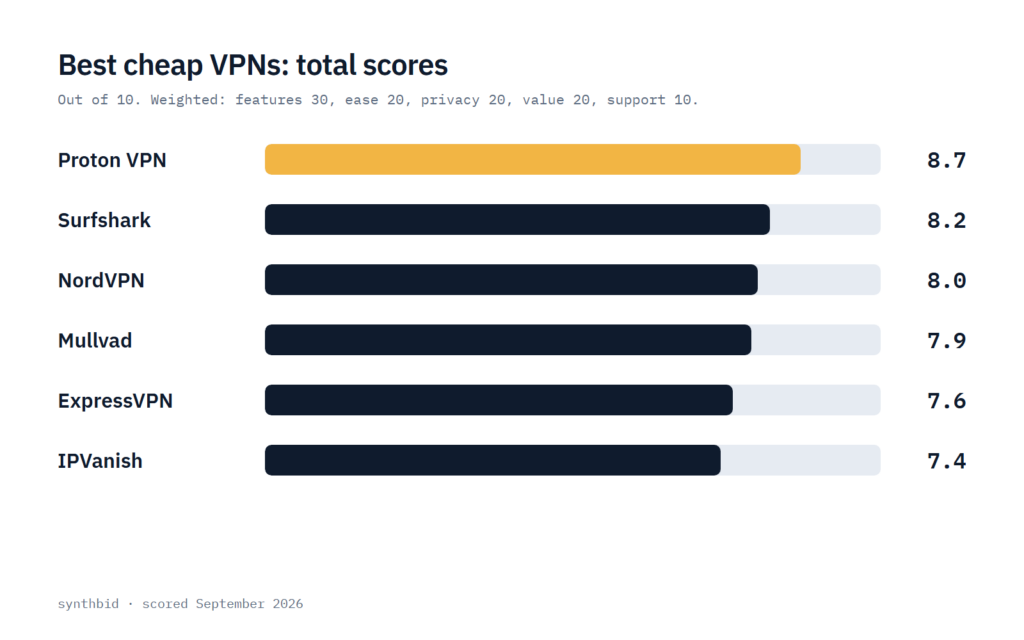
- Proton VPN ranks first, and its Plus plan renews at $83.88 a year, a smaller step up than at NordVPN, ExpressVPN or IPVanish.
- NordVPN is the one to watch: $3.49 a month for the first 27 months becomes $139.08 a year at renewal.
- Mullvad charges €5 a month at any term, so it has no first-term price to fall off.
I ranked six VPNs on the checklist I use for every ranking: core features 30, ease of use 20, privacy and data 20, value 20 and support 10, as described on How I test. For this list, cheap means a long plan that starts under $4 a month, or a flat rate of about €5. The question I put to each service is what the plan costs once the first term is over, so the renewal price drives the value score.
That second price is the one that catches people. PCMag notes that long-term deals advertised at $2 to $4 a month usually need two or three years paid at once, and that renewal prices often rise significantly when the deal period ends. A CNET buying guide gives the same warning and adds that some providers make you dig through their terms pages to find the true yearly price.
So each entry below leads with the renewal price and treats the first-term price as the exception. The scores for the five services that also appear in my ranking of the best VPNs are the same ones I use there, and IPVanish is new to this list.
The ranking at a glance
| VPN | Score | Price | Best for |
|---|---|---|---|
| 1. Proton VPN | 8.7 | $3.49/mo, then $83.88/yr | A strong privacy record and a free plan to fall back on |
| 2. Surfshark | 8.2 | $2.49/mo, then between $79 and $99/yr in reviews | Households with many devices |
| 3. NordVPN | 8.0 | $3.49/mo, then $139.08/yr | Features and speed, if you plan the exit |
| 4. Mullvad | 7.9 | €5/mo, flat | A price that never steps up, and the least account data |
| 5. ExpressVPN | 7.6 | $2.99/mo, then $99.95/yr | A polished app, at a higher renewal |
| 6. IPVanish | 7.4 | $2.39/mo, then $89.99/yr in reviews | Unlimited devices, if you accept the renewal |
First-term prices come from each company’s pricing page, checked September 2026. Renewal prices marked reviews come from the published reviews linked in Sources.
Proton VPN: the best pick once renewals count
Proton VPN is the one I would pick if you want the price to stay sensible after the offer ends. The paid Plus plan costs $9.99 a month, and the two-year plan brings that to $3.49 a month, billed as $83.76 for the first 24 months. After that it renews at $83.88 every 12 months, which is $6.99 a month.
That renewal is lower than NordVPN’s, ExpressVPN’s or IPVanish’s, and Proton also keeps a free plan for anyone who would rather not pay at all. CNET names it the best cheap VPN and says its renewal rates are cheaper than most of the competition.
The weak spots in the sources are latency, which one published list marks as a con, and live chat. The same guide says there is no 24/7 chat, while the pricing page lists priority support and live chat on Plus, so I would expect support to be fine but not around the clock.
Why 8.7. Core features get 8.5 for 10 devices, ad and tracker blocking and streaming support, held back by the latency note. Ease of use gets 9.0 because reviewers describe a slick, accessible app. Privacy gets 9.5 for a record I rate highest of the six, value gets 8.5 for the free plan and a moderate renewal, and support gets 7.5.
Scores: core 8.5, ease 9.0, privacy 9.5, value 8.5, support 7.5. Total 8.7.
Surfshark: cheap to start, unclear to keep
Surfshark’s two-year Starter plan is $2.49 a month, billed as $67.23 for the first 27 months, and the plan includes unlimited devices. Month to month it is far dearer, at $15.45 in two reviews, so this is a service to buy on a long plan and on purpose.
The renewal is where the sources split. The pricing page I saved does not show a renewal price. One review says the plan renews at $99 a year, while another says $79, which is a large gap for the same plan. At $79 a year the monthly cost would be $6.58, and at $99 it would be $8.25.
The first of those reviews adds that recent price changes have made the renewal less of a steal, which fits the higher figure. I would plan for $99 until Surfshark states it, and read the checkout page before paying. The rest of the picture is in my Surfshark review.
Why 8.2. Core features get 8.5 and ease of use 8.5 for a long feature list that includes multi-hop and split tunneling. Privacy gets 8.0. Value gets 8.0 because the first term is cheap but the renewal is disputed, and support gets 7.5.
Scores: core 8.5, ease 8.5, privacy 8.0, value 8.0, support 7.5. Total 8.2.
NordVPN: the biggest step up
NordVPN has the widest gap between its two prices. Basic is $3.49 a month if you take the two-year plan, billed as $94.23 for the first 27 months. After that the renewal is $139.08 a year, or $11.59 a month.
A shorter term does not fix it. The one-year Basic plan is $5.49 a month, $65.88 for the first 12 months, and it renews at the same $139.08. Month to month costs $14.99, and every plan carries a 30-day refund window.
The case for staying is features. Security.org credits it with the best price-to-feature ratio on its cheap list and notes a limit of 10 devices at once, and one guide counts it among the fastest VPNs it has tested. The same page also warns that prices may rise after the first subscription, and the pricing page confirms it.
Why 8.0. Core features get 9.0 for the extras and the speed, and ease of use gets 8.5. Privacy gets 8.0 on an audited no-logs claim. Value gets only 6.5 because the renewal is the largest step in this ranking, and support gets 7.0.
Scores: core 9.0, ease 8.5, privacy 8.0, value 6.5, support 7.0. Total 8.0.
Mullvad: nothing to fall off
Mullvad is the only service here with no first-term price to fall off. It charges the same €5 a month for a month, a year or a decade, and the pricing page says the rate has not changed since 2009.
Because the price is in euros, the dollar cost moves with the exchange rate: the page showed €5 as $5.63 on the day I checked. There is no free version, the refund window is 14 days, and one account covers up to 5 devices.
The trade-offs are practical ones. One review says Mullvad struggles with some streaming services and runs a relatively small server network, and another calls the desktop interface awkward. In return you get an anonymous account number in place of an email and password.
Why 7.9. Core features get 7.5 and ease of use 7.0 for the streaming gaps and the awkward desktop app. Privacy gets 9.5 for the anonymous account, and value gets 8.0 because the price never steps up, even though it is not the lowest first-term price. Support gets 7.5.
Scores: core 7.5, ease 7.0, privacy 9.5, value 8.0, support 7.5. Total 7.9.
ExpressVPN: a higher renewal for a polished app
ExpressVPN advertises Basic at $2.99 a month, billed as $83.72 for the first 28 months on the two-year plan. The plan then renews automatically at $99.95 a year, which is $8.33 a month, and the pricing page says so right under the price, which not every rival does.
Basic covers 10 devices and carries a 30-day refund for new customers only. One guide groups it with the pricier services, at as much as $75 for a first year, though it also counts ExpressVPN among the fastest VPNs it has tested.
My view is that the speed and the polished app are what the extra money buys, and whether that is worth it depends on how much you would notice. If you want the detail, my ExpressVPN review covers the tiers and the audits.
Why 7.6. Core features get 8.0 and ease of use 8.5 for a fast, consistent app with a short list of extras. Privacy gets 8.0. Value gets 6.0 because $99.95 a year is a lot for the VPN-only tier, and support gets 7.0.
Scores: core 8.0, ease 8.5, privacy 8.0, value 6.0, support 7.0. Total 7.6.
IPVanish: the lowest first term, with a hidden renewal
IPVanish shows the lowest first-term price in this ranking. Essential is $2.39 a month, billed as $57.36 for the first 2 years, and the plan includes unlimited devices and live chat around the clock.
Two reviews report that it renews at $89.99 a year, which is $7.50 a month. The first of them says the pricing page and the offer page do not show that figure, and that you have to find the renewal page or an FAQ answer. The page I saved shows only first-term prices.
Both reviews were written when the two-year Essential plan cost $52.56, and the page now shows $57.36, so check the number at checkout. Month to month, one review lists Essential at $12.99.
IPVanish says on its pricing page that it is a Ziff Davis company, and PCMag belongs to the same group. The cheap list I cited at the start does not include IPVanish, so I mention the link only so you can weigh the reviews yourself.
Why 7.4. Core features get 8.0 for unlimited devices and the extras on Essential, and ease of use gets 8.0. Privacy gets 7.5. Value gets 6.0 because the renewal is hard to find and the monthly price is high, and support gets 7.0 even though live chat is advertised around the clock.
Scores: core 8.0, ease 8.0, privacy 7.5, value 6.0, support 7.0. Total 7.4.
Cheaper to keep, but not ranked
Some cheap services are not in the ranking because I have not scored them. Private Internet Access is the clearest case. One review lists it at $40 for the first year, renewing at $50 a year, and a Security.org table prices a 3-year plan at $79. Those figures come from reviews and not from an official page I saved, so treat them as a pointer.
The cheap list I cited at the start also names TunnelBear, Windscribe and IVPN. It prices Windscribe at $9 a month, or from $3 a month with its Build a Plan option. If the renewal step is what bothers you most, those are worth pricing against Mullvad’s flat rate.
Before the first term ends
Choose the term on purpose. That guide prefers annual plans for the balance of value and risk, at $40 to $100 for the first year, and a shorter term brings the renewal date forward so you decide again sooner. A two-year plan is cheaper per month, but it is a longer bet on a service you may not like.
Then put the renewal date in your calendar on the day you pay, and check what a new signup costs a few weeks before it arrives. Every service in the table below has a refund window, and one reviewer suggests using it to find out whether a VPN suits you before you settle in.
If you would rather never watch a date, a true monthly plan avoids the step entirely, at a price. One review defines cheap as a monthly price under $10 and notes that a monthly plan gives you more flexibility if the quality drops.
Pricing
| Plan | First term | Renews at | Month to month | Refund |
|---|---|---|---|---|
| Proton VPN Plus | $3.49/mo, $83.76 for 24 months | $83.88 a year | $9.99 | 30 days |
| Surfshark Starter | $2.49/mo, $67.23 for 27 months | $79 to $99 a year (reviews) | $15.45 (reviews) | 30 days |
| NordVPN Basic | $3.49/mo, $94.23 for 27 months | $139.08 a year | $14.99 | 30 days |
| Mullvad | €5/mo at any length | No step up | €5 | 14 days |
| ExpressVPN Basic | $2.99/mo, $83.72 for 28 months | $99.95 a year | Not listed | 30 days for new customers |
| IPVanish Essential | $2.39/mo, $57.36 for 2 years | $89.99 a year (reviews) | $12.99 (reviews) | 30 days |
Prices from each company’s pricing page, checked September 2026. Figures marked reviews come from the published reviews linked in Sources.
FAQ
What is the cheapest but best VPN?
On the figures I could source, Mullvad is the cheapest to keep, because €5 a month never changes. For the best balance of price, record and features I would pick Proton VPN, which scores 8.7 and renews at $83.88 a year. IPVanish has the lowest first-term price at $2.39 a month, but reviews put its renewal at $89.99 a year.
Which VPN is 100% free?
None is free without a catch, and I would not trust a no-name free VPN. In this ranking only Proton VPN has a free plan: it costs nothing and has no data limit according to one review, but the pricing page caps it at 1 device and medium speed. My guide to the best free VPNs goes through the options.
Why avoid NordVPN?
The complaint I find fair is the renewal, not the product. NordVPN gets 9.0 from me on core features, but its value score is 6.5 because $139.08 a year is more than the other renewals here. If you turn off auto-renewal and decide again before the term ends, it is still a strong service, and my NordVPN review goes through it.
Should I buy the longest plan?
Only if you are already sure you want the service. The longest plan has the lowest monthly price, but it ties up the most money, and the renewal that follows is the price you will actually live with. A one-year plan costs more per month and lets you decide again sooner.