Bottom line
- Proton VPN is my pick: its free plan has no data cap and no ads, and the price is one device at a time and 10 countries chosen for you.
- Windscribe and PrivadoVPN cap free use at 10GB a month and TunnelBear at 2GB, so I treat those three as light-use plans or a way to try the app.
- Skip any free VPN with no visible way of earning money, because the two roundups I read both warn that such services may sell your data.
Every plan in this ranking comes from a company that also sells a paid VPN, because a free plan with a visible source of income is the only kind I would consider. I scored the six on the five checks used for every ranking here. Features carry the most weight, then ease, privacy and value at equal weight, and support last, with weights of 30, 20, 20, 20 and 10. Limits and prices come from each company’s own pages, and published tests from ZDNET and Cybernews fill in speed and day-to-day use. For a free plan, value means how much you get before the catch bites.
What free costs you
A free VPN has to be paid for somehow, and the way it pays tells you most of what you need to know. Proton VPN says its free plan is supported by paying users, which is the model I trust most. Hotspot Shield says its free plan is ad supported. The kind to avoid earns its money by collecting your data and selling it on.
In this list the catch comes in four forms.
- Data caps. Windscribe and PrivadoVPN allow 10GB a month, and TunnelBear allows 2GB. Proton VPN and Hide.me hold back something else.
- Devices. Proton VPN, Hide.me and Hotspot Shield cover one device at a time on a free account, and PrivadoVPN’s pricing page says the same.
- Locations. Hide.me gives you 8 locations, Proton VPN 10 countries picked at random, and Hotspot Shield US servers only, according to one review.
- Speed and extras. Hide.me lists restricted speeds and Proton VPN lists medium speed, and Proton keeps streaming, P2P and its ad blocker for paid plans.
One publisher’s analysis of free VPN traffic found that the average free app carries 5 embedded third-party tracking libraries, against 1 in the average paid app. I treat that as a warning and not as a ranking input, since it comes from a single analysis.
Streaming, torrenting and gaming are where free plans fall down. One review of free plans says speed and bandwidth limits make them unsuitable for all three, and that free servers tuned for streaming are rare. If one of those is your reason for wanting a VPN, read the trials section before you install anything.
The ranking at a glance
| Product | Score | Price | Best for |
|---|---|---|---|
| 1. Proton VPN | 8.7 | Free; Plus $3.49/mo | The one free plan with no data cap and no ads |
| 2. Hide.me | 7.8 | Free; paid $2.69/mo | No sign-up, no ads and plain privacy |
| 3. Windscribe | 7.6 | Free, 10GB/mo; Pro $5.75/mo | Covering many devices on a free plan |
| 4. PrivadoVPN | 7.2 | Free, 10GB/mo; paid $1.11/mo | Streaming on a small monthly allowance |
| 5. TunnelBear | 7.1 | Free, 2GB/mo; paid from $3.33/mo | The friendliest app, for light use |
| 6. Hotspot Shield | 6.7 | Free; Premium $1.99/mo | US servers and a fast protocol, with ads |
Prices are the lowest paid prices listed on each company’s page, checked July 2026. The Pricing section below shows the billing terms.
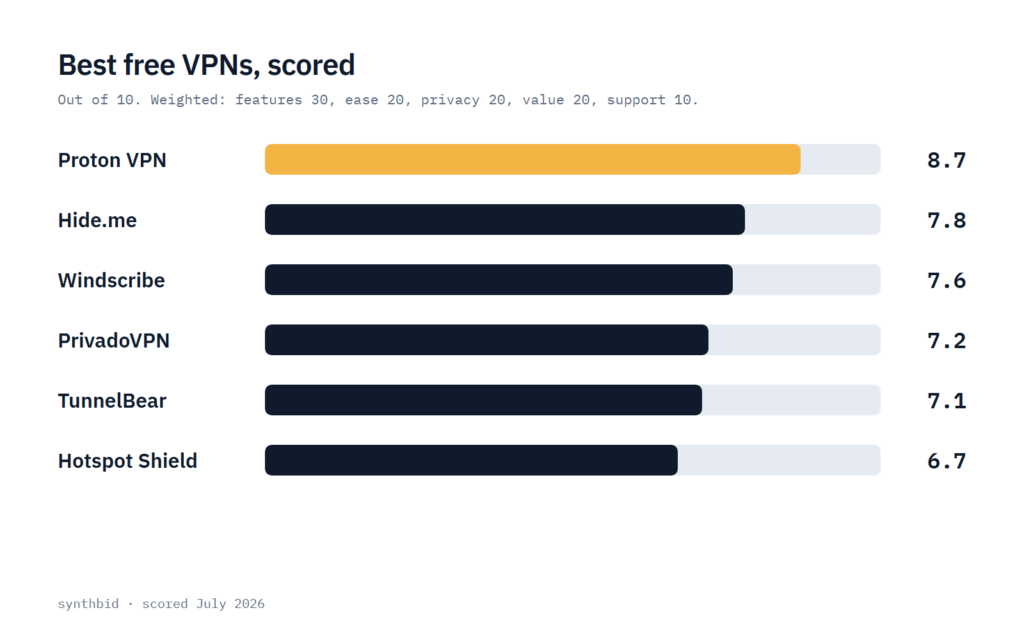
The six free VPNs in order
The scores are mine. The limits, prices and test results inside each entry come from the vendor’s pages or from a published review, and I say which where they disagree.
Proton VPN: best overall
Proton VPN has the free plan I would hand to a friend. It carries no data cap and no ads, and Proton says it is paid for by people who subscribe to the paid plans. The price of that is one device at a time and servers in 10 countries that the app picks for you, as the pricing page lists them.
Proton’s marketing says the free plan has no speed limits, while its pricing page rates the free speed as medium. In a published test on a UK server, speed held at around 40% of the tester’s baseline. That is lower than paid VPNs but steady, because nothing is capped.
The free plan keeps the safety basics: a kill switch, the Stealth protocol for getting around blocks, and a no-logs policy that one review says independent audits have confirmed. Streaming, P2P, the NetShield ad blocker and Secure Core are listed as paid features. One review got Netflix and Hulu to open on the free plan after a few tries, which does not match Proton’s own list, so I would not count on it.
You do need an account. Proton’s page asks you to create one, with no credit card, although one review says no sign-up is needed. The paid VPN Plus plan is listed at $3.49 a month, charged as $83.76 for 24 months, and the page says it then renews at $83.88 for each 12 months, which is $83.88 ÷ 12 = $6.99 a month. A 30-day money-back guarantee applies, and I cover the paid plan in my Proton VPN review.
Why 8.7. I score core features 8.5 for a free plan that keeps the kill switch and Stealth protocol, and ease of use 9.0 for an app that one review calls very easy to use. Privacy gets 9.5 for a no-logs claim backed by audits and a Swiss base, and value gets 8.5 for an uncapped free plan offset by the renewal rate. Support gets 7.5 because live chat and priority support are listed as part of Plus.
Scores: core 8.5, ease 9.0, privacy 9.5, value 8.5, support 7.5. Total 8.7.
Hide.me: best for no sign-up
Hide.me is the closest rival to Proton on privacy terms. Its free plan needs no registration, shows no ads and keeps no logs, and the company is based in Malaysia, which one review notes sits outside the Eyes alliance. You get 8 server locations and one device at a time, according to the free VPN page.
The pricing page lists the free plan’s data as unlimited and its speeds as restricted, and the tests are uneven. One test found speeds that were either above 80% of the baseline or very poor, at 9.6Mbps down and 1Mbps up, depending on server and time of day. The same review says the old 10GB monthly cap was reported removed while the FAQ still mentioned it.
Streaming is the weak spot. That reviewer only got Netflix to load after several tries and found gaming and torrenting frustrating, so I would use Hide.me for browsing on public Wi-Fi and not for entertainment.
Paid Hide.me Premium is listed at $2.69 a month, billed at $69.99 every 26 months, and the page says a plan always renews at the same price and duration. That is the clearest renewal promise in this list. There is a 30-day money-back guarantee.
Why 7.8. I score core features 7.0 because of the 8 locations, one device and restricted speeds, and ease of use 8.0 for no sign-up and a plain app. Privacy gets 8.5 for the no-logs policy, no ads and the Malaysian base. Value gets 8.0 for a free plan with no stated data cap and a flat renewal promise, and support gets 8.0 because Hide.me offers free users help at any hour and one review lists support among its strengths.
Scores: core 7.0, ease 8.0, privacy 8.5, value 8.0, support 8.0. Total 7.8.
Windscribe: best for many devices
Windscribe’s free plan lets you connect as many devices as you like, with a 10GB monthly allowance and servers in 10 countries. That makes it the plan I would pick for a household that wants every device covered for light use, as long as nobody streams.
The same review picks it for getting around censorship, saying recent configuration updates make it a likely best bet in places such as Iran, Russia and China. It also lists a browser extension and calls the bandwidth limited but generous, and it does not recommend any free VPN for China itself.
On privacy, Windscribe’s features page describes no identifying logs, meaning it says it cannot identify you from your IP address and a timestamp. That wording is narrower than the plain no-logs claim from Proton and Hide.me. The paid plan lists unlimited data, servers in over 69 countries, config generators and the R.O.B.E.R.T. blocker for ads, trackers and malware.
Windscribe Pro costs $9.00 a month on the monthly plan or $69 billed every 12 months, which is $69 ÷ 12 = $5.75 a month, according to the upgrade page. The review’s table lists a lowest paid price of $2.42 a month, which I could not match to a plan on that page. The only cheaper route there is a Build a Plan option at $1.00 per location per month.
Why 7.6. I score core features 8.0 for broad features and an open device policy, and ease of use 7.5 for an app with many settings. Privacy gets 7.5 because the no-identifying-logs wording is narrower and the pages I read give no audit details. Value gets 7.5 because the 10GB cap and a $5.75 yearly price sit against free unlimited devices, and support gets 7.0 because the pages I read say little about it.
Scores: core 8.0, ease 7.5, privacy 7.5, value 7.5, support 7.0. Total 7.6.
PrivadoVPN: best for streaming on a small allowance
PrivadoVPN gives you 10GB of data a month, which its page says refreshes every 30 days, across 13 free server locations. One review picks it as the best free VPN for streaming, but the allowance is the catch, and the same review warns you may use it up sooner than you think.
A free account has no ads, a zero-log policy and, the free VPN page says, Swiss privacy law behind it. The review lists P2P support and a bare interface. The two Privado pages disagree on devices: the free-plan page says the free apps work on unlimited devices, while the pricing page says a free account covers 1 device. I would plan for one.
Paid PrivadoVPN is the cheapest in this ranking by listed monthly rate: $1.11 a month on the 24-month plan, $1.33 on the 12-month plan and $10.99 for a single month. The page does not show the total billed or the renewal price, so I would check the checkout screen before paying. A 30-day money-back guarantee is listed.
Why 7.2. I score core features 7.0 for 13 locations held back by the 10GB limit, and ease of use 7.0 because the review calls the app bare. Privacy gets 8.0 for zero logs and Swiss jurisdiction as the company states them, and value gets 7.0 for a low paid price against a small free allowance. Support gets 7.0 because the page lists 24/7 support and I found no review of it.
Scores: core 7.0, ease 7.0, privacy 8.0, value 7.0, support 7.0. Total 7.2.
TunnelBear: best app for light use
TunnelBear has the friendliest app in this list and the smallest allowance, at 2GB of data a month on the pricing page. One review adds that free users get servers in 47 countries but cannot choose which one they connect to, and that torrenting is not available on the free plan.
Privacy features match the paid plan: AES-256 encryption, a no-logs policy, a kill switch and obfuscation. Split tunneling was removed from the free tier in early 2025. TunnelBear says it publishes annual security audits. In March 2026 one review dropped it as a top free pick, citing the limits on server choice and the 2GB cap.
The pricing page lists country selection, split tunneling, unlimited devices and priority support under the paid plan, which starts at $3.33 a month. It shows no billing terms or renewal price.
Why 7.1. I score core features 6.5 for the 2GB cap, random server choice and no torrenting, and ease of use 8.5 for the friendliest app here. Privacy gets 8.0 for paid-level privacy features and the audits it says it publishes, value gets 6.0 because 2GB goes quickly, and support gets 6.5 because priority support is listed as a paid feature.
Scores: core 6.5, ease 8.5, privacy 8.0, value 6.0, support 6.5. Total 7.1.
Hotspot Shield: a fast protocol, with ads and mixed reports
Hotspot Shield is the plan where the sources disagree most. Its free VPN page says Basic has unlimited bandwidth and 1 device. One review reports a daily cap of 500MB that ran out before a single episode finished, and another lists a 15GB monthly allowance. I cannot say which is right, so I treat the cap as unknown.
Ads are part of the deal. The page lists no ads next to the Basic plan yet also says the service is ad supported, and both reviews describe ads. Free servers are in the US only, according to one review, which suits US content and limits everything else. That test measured about 16% of the tester’s usual speed and noted that Hotspot Shield is not a zero-knowledge provider, although it keeps a no-logs policy and AES-256 encryption on the free plan.
Premium is listed at $1.99 a month, and the page says it auto-renews monthly at $12.99 a month, with a 45-day refund window. The two reviews quote other starting prices, $2.99 and $8, so check what the checkout shows.
Why 6.7. I score core features 6.5 for US-only free servers and an unclear cap, and ease of use 7.5 for broad platform support and a stable connection. Privacy gets 6.5 because it is ad supported and not zero-knowledge, and value gets 6.5 for the same reasons. Support gets 6.5 because one review lists limited support on free plans, even though the company says 24/7 live support.
Scores: core 6.5, ease 7.5, privacy 6.5, value 6.5, support 6.5. Total 6.7.
When a free trial beats a free plan
If you want streaming, several devices or full speed, a free plan will not deliver them, and a paid VPN’s trial or refund is the cleaner test. One review notes that mobile trials usually last up to a week, while 30 or 45-day money-back guarantees charge you up front and expect you to ask for the refund before the window closes.
Surfshark offers a seven-day free trial on Mac, iOS and Android. NordVPN is tried through its 30-day money-back guarantee, and the review lists limited free use and no unlimited simultaneous connections among its drawbacks. Its renewal pricing is why its value score is 6.5 in my NordVPN review. Proton’s free plan is the gentlest version of this: you start free, and if you upgrade the 30-day guarantee covers you.
Free VPNs I would not install
Some names keep appearing in warnings. Reviewers say Hola VPN lends your connection to other users, Urban VPN collects identifiable data such as your IP address, and Hoxx VPN uses weak encryption. Another publisher notes that Hola VPN was exposed in 2015 for selling users’ bandwidth to a botnet.
Leaks matter as well. One publisher says it found databases holding the personal data of 21 million users from SuperVPN, GeckoVPN and ChatVPN, including plaintext passwords listed for sale.
Fake listings are a separate risk. One review reports lookalike free versions of legitimate VPNs that slipped past app store vetting, so I would download only from the vendor’s own links and read the reviews first. Before installing any free VPN, I would check who pays for it, whether it names the company and where it is based, and whether it publishes a no-logs policy or an audit.
Pricing
| Paid plan | Price | Billed | Refund |
|---|---|---|---|
| Proton VPN Plus | $3.49/mo | $83.76 for 24 months, then $83.88 every 12 months | 30 days |
| Hide.me Premium | $2.69/mo | $69.99 every 26 months, same price on renewal | 30 days |
| Windscribe Pro | $5.75/mo | $69 every 12 months, or $9.00 monthly | Not shown |
| PrivadoVPN | $1.11/mo | 24-month plan, total not shown | 30 days |
| TunnelBear Unlimited | from $3.33/mo | Billing terms not shown | Not shown |
| Hotspot Shield Premium | $1.99/mo | Auto-renews monthly at $12.99/mo | 45 days |
Prices from each company’s pricing page, checked July 2026.
Two of these rise sharply after the first term. Proton VPN Plus is $83.76 ÷ 24 = $3.49 a month at signup and roughly double that on renewal, and Hotspot Shield’s page says $12.99 a month after the $1.99 offer. Hide.me is the opposite, because it states that the price and term stay the same on renewal. For Windscribe, TunnelBear and PrivadoVPN the pages I read give no renewal price, so I would check before paying. The Hotspot Shield figures come from its free VPN page.
FAQ
What is the best fully free VPN?
Proton VPN, in my ranking. It is the only plan here with no data cap and no ads, which is why it scores 8.7, and the limit is one device at a time. Hide.me is the runner-up if you want no sign-up at all.
Is there a VPN that is 100% free?
Proton VPN and Hide.me both describe their free plans as free for good with no data cap, so in the sense of costing nothing and not expiring, yes. Neither is without limits: both cover one device and a limited set of locations, and Proton keeps streaming and P2P for paid plans. Windscribe and PrivadoVPN never ask for money either, but they cap data at 10GB a month.
Why avoid NordVPN?
I would not say avoid it. NordVPN is a paid service, so it is not in this ranking, and the reason I score its value 6.5 is the renewal price, which I cover in my NordVPN review. If cost is the question, a free plan from this list or a paid plan inside its refund window is the cheaper way to test a VPN.
Can a free VPN stream Netflix?
Sometimes. One review got Netflix and Hulu to open on Proton’s free plan after a few tries, but another says free plans are unlikely to suit streaming, and Proton lists streaming as a paid feature. Anyone who needs streaming should pick a paid plan and use it inside the refund window.
Sources
- Proton VPN, free plan page
- Proton VPN, pricing page
- Hide.me, free VPN page
- Hide.me, pricing page
- Windscribe, features page
- Windscribe, upgrade page
- PrivadoVPN, free VPN page
- PrivadoVPN, pricing page
- TunnelBear, pricing page
- Hotspot Shield, free VPN page
- ZDNET, best free VPNs list
- Cybernews, best free VPN services