Bottom line
- Bitdefender is my top pick: strong lab results and a light footprint in two reviews, and first or tied for first in three of the four roundups I read.
- Norton has the deepest lab record, but its first-year deal is about half the price you pay once it renews.
- Windows already ships with Microsoft Defender, so what you pay a vendor for is extras, support and cover for your other devices.
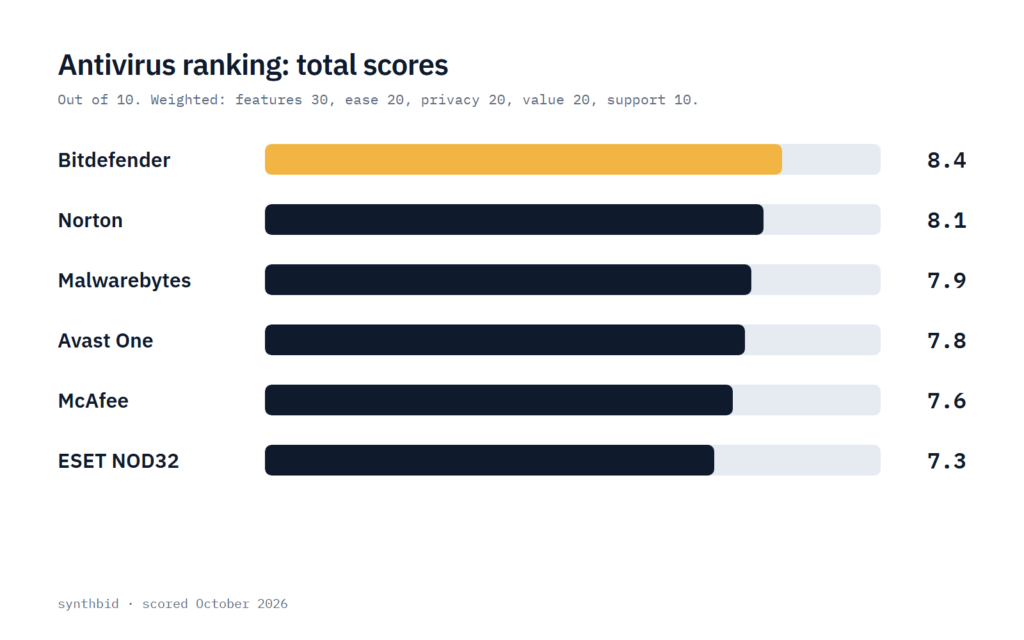
Antivirus roundups tend to agree on the top two or three names and disagree on almost everything below them. I read four recent ones, checked the vendors’ own pages where I could, and ranked six programs for a Windows PC on the five checks I apply to everything on this site: its core protection, day-to-day ease, data handling, cost against benefit and the quality of support. They are weighted 30, 20, 20, 20 and 10, and the How I test page explains why.
The six are the programs that at least three of those four roundups covered. Kaspersky is missing on purpose: reviewers stopped recommending it after the US ban on new sales, which one roundup dates to June 2024.
The ranking at a glance
| Program | Score | Price | Best for |
|---|---|---|---|
| 1. Bitdefender Antivirus Plus | 8.4 | from $24.99 in year one | Most people: strong lab results and a bank-safe browser |
| 2. Norton AntiVirus Plus | 8.1 | from $29.99 in year one | The deepest lab record, if you watch the renewal |
| 3. Malwarebytes | 7.9 | from $26.99 in year one | A light, simple app, or a second opinion on a PC |
| 4. Avast One | 7.8 | Free, with paid tiers | One PC on a zero budget, if you accept its history |
| 5. McAfee | 7.6 | from $30 in year one | Households that need many devices covered |
| 6. ESET NOD32 Antivirus | 7.3 | $39.99 for the first term | People who like to adjust settings |
Prices are first-year prices. The Pricing section below says where each one comes from and what the program costs after that.
Bitdefender Antivirus Plus: best overall
I would install Bitdefender first on a Windows PC. One roundup names Bitdefender Antivirus Plus its best overall pick with a rating of 4.5, another puts Bitdefender Total Security at the top of its list, and a third ties it with Malwarebytes for first place with a score of 8.8. Only one of the four ranks it lower, in seventh place, and even that one scores it 8.7.
The lab record is clean. A February 2026 round of AV-Comparatives tests gave it a perfect score, and a separate review reports 6 out of 6 from AV-TEST for protection, performance and usability on Windows. It also has multi-layered ransomware protection and an isolated browser for banking.
There are weak spots. PCMag’s own malware-blocking test gave it only a mediocre result, and the roundup that praises its detection says Malwarebytes is better at cleaning an infection that is already on the PC. A full scan takes over an hour in that review, although quick scans finish in 15 to 30 seconds. In a lab performance test in April 2026 it also scored 9.6, where lower is better, against 5.3 for Norton and 3.3 for McAfee.
Bitdefender’s page offers a plan for 1 device or 3, and the bundled VPN is limited to 200MB a day per device, so I treat it as a taster. If you want a proper VPN, my best VPN ranking covers the options. Reviews disagree on what renewal costs: one lists $25 for the first year and $50 after, another shows $34.99 for the first year next to $69.99.
Why 8.4. I give core features 9.0 for the lab record and the ransomware layer, held back by the mediocre malware-blocking result and slow removal of existing infections. Ease of use gets 8.5 for apps one review calls easy to use on every platform. Privacy gets 8.0 for tracker blocking and data-monitoring tools, but I found no clear account of how it handles customer data on the pages I read. Value gets 8.0 for a low first-year price, offset by a possible doubling at renewal and a five-device cap on individual plans. Support gets 8.0 for round-the-clock help and phone support, offset by a chat that starts with an AI and makes it hard to reach a person.
Scores: core 9.0, ease 8.5, privacy 8.0, value 8.0, support 8.0. Total 8.4.
Norton AntiVirus Plus: the deepest lab record
Norton has the strongest lab record of the six. PCMag says Norton AntiVirus Plus holds perfect scores from five independent labs and tops the aggregate lab ranking that roundup builds, and Security.org puts Norton first overall with a score of 9.7.
AntiVirus Plus does more than scan. Norton’s page lists scam protection, a password manager, a firewall and 2 GB of cloud backup, for 1 device. Norton 360 Deluxe, the plan one roundup reviews, covers 5 devices and adds a VPN, parental controls and 50 GB of backup.
The catch is the price. For one device the page shows $29.99 for the first year and $59.99 after, and Norton 360 Deluxe goes from $49.99 to $124.99. One roundup warns that prices can double or more after the first year, and Norton’s own page says renewal prices may be higher than the initial price.
Resource use is where the sources differ. In the April 2026 lab performance test, Norton scored 5.3, better than Bitdefender’s 9.6, but one reviewer saw it use up to 40% of the CPU during scans. Support is a split verdict too: one roundup lists 24/7 phone and live chat, while another says reaching a person can be difficult. The identity features are only available to US customers, so if those are your reason to buy, my identity theft protection ranking compares the dedicated services. A 60-day money-back guarantee is listed on that page.
Why 8.1. I give core features 9.0 for the perfect lab scores and ransomware protection, held back by a poor result in one of the malware tests. Ease of use gets 8.5 for a clean interface where a scan is one button. Privacy gets 8.0 for scam and tracking tools, held back by identity features limited to the US. Value gets 7.0 because the price roughly doubles at renewal. Support gets 7.0 because the sources disagree on how easy it is to reach a person.
Scores: core 9.0, ease 8.5, privacy 8.0, value 7.0, support 7.0. Total 8.1.
Malwarebytes: light and simple, with a thinner record
Malwarebytes is the entry the roundups argue about most. One roundup ties it with Bitdefender for first place at 8.8 and praises its low resource use, while TechRadar ranks it seventh and calls it not the best first line of defense but excellent at removing threats already on a device. Another roundup rates the paid version 4.0 and calls it best for speedy scans.
On the pricing page the paid antivirus is called Standard. It covers 3 devices for $35.99 in the first year, marked down from $59.99 in a sale the page says is for the first year only, and a one-device version costs $26.99 against $44.99. The page offers a 60-day money-back guarantee, and one roundup notes you pay extra to cover more than three devices.
That roundup also lists Windows optimization tools and a personal data remover that works only in the US, with a slow VPN and no phone support. My Malwarebytes review goes through the free and paid versions in detail.
Why 7.9. I give core features 8.0 for a near-perfect malware-blocking score and a perfect score from one lab, held back by that single lab and by a roundup saying its real-time protection is weaker than Bitdefender’s. Ease of use gets 8.5 for fast scans and a simple app. Privacy gets 8.0 for a plain privacy policy, which my review covers. Value gets 7.5 because extra devices cost more. Support gets 7.0 for quality chat but no phone line.
Scores: core 8.0, ease 8.5, privacy 8.0, value 7.5, support 7.0. Total 7.9.
Avast One: the free option, with a history
Avast One is the free pick here. Its free tier, Avast One Basic, covers a single device and includes real-time protection, ransomware tools and a simple firewall. Paid tiers add scam SMS blocking, deepfake detection and the SecureLine VPN, and one roundup says those extras do not affect how well it protects against viruses.
The lab numbers are good. In February 2026 it earned a perfect 6/6 from AV-TEST, in April 2026 it scored 5.5 in a performance test where lower is better, and in May 2026 it blocked 99.3% of test threats in an AV-Comparatives evaluation. Another roundup puts its aggregate lab score at 9.8, from five labs.
Privacy is the problem. In 2024 the Federal Trade Commission fined Avast $16.5 million over charges that it sold customer data to over 100 third parties between 2014 and 2020 through a subsidiary called Jumpshot, which Avast closed in 2020. One roundup says it has not re-tested Avast in recent years and recommends choosing among the products it has vetted. The lab results say the engine works. The open question is whether you trust the company with your data, which is why privacy is the lowest score in this ranking.
Why 7.8. I give core features 8.5 for strong lab results and a free tier that covers the basics. Ease of use gets 8.5 for apps and a simple install that one review praises. Privacy gets 6.0 because of the data-selling case. Value gets 8.5 because the free tier costs nothing, held back by a one-device limit and paid extras. Support gets 6.5 because none of the roundups I read rates it, so I treat it as unproven.
Scores: core 8.5, ease 8.5, privacy 6.0, value 8.5, support 6.5. Total 7.8.
McAfee: pick the edition carefully
McAfee has strong lab results and two very different editions. In June 2026 a lab round gave McAfee 6/6 and its Top Product award, and an April 2026 performance test scored it 3.3, better than any other figure quoted here. The edition one roundup picked, McAfee AntiVirus, covers just one Windows PC with no volume discount, while the McAfee+ plans in the other roundups cover unlimited devices.
The sources disagree on how light it is. Despite the good lab impact score, one reviewer saw it use as much as 80% of the CPU during scans, and another found that some scans took more than two hours and that files loaded slower with real-time protection on. One roundup also reports that it missed two ransomware samples in testing.
Price is the other weak point. One roundup lists $30 for the first year and $90 a year after, and another lists the McAfee+ Premium Family plan at $69.99 for the first year and $169.99 a year after that. In return you get an online account cleanup tool and a personal data removal tool that a reviewer likes.
Why 7.6. I give core features 8.0 for the lab scores, held back by the missed ransomware samples and heavy scans. Ease of use gets 8.0 for apps reviewers find easy to navigate. Privacy gets 8.0 for the data cleanup tools. Value gets 6.5 because the price triples at renewal in one listing. Support gets 7.0 because one reviewer lists no email support.
Scores: core 8.0, ease 8.0, privacy 8.0, value 6.5, support 7.0. Total 7.6.
ESET NOD32 Antivirus: for people who tweak settings
ESET NOD32 Antivirus suits people who like to adjust settings. One roundup says it scores better with the independent labs than almost any competitor, with perfect or near-perfect scores from four of them, and it includes device control and a SysInspector tool for detail about the PC. The same roundup gave it a poor score in its malware-blocking test and found its ransomware protection not effective.
The roundups disagree sharply. Another reports a 98.3% online detection rate and a 100% online protection rate for NOD32 in a September 2025 lab test, while TechRadar ranks the related ESET Home Security tenth and calls it outdated, okay for basic protection and behind better options.
On ESET’s page, NOD32 costs $39.99 for 1 device for the first term, and ESET Home Security Essential and Premium are listed at $59.99 and $89.99 for 3 devices. The page says prices are valid for the first term only, and it offers a 30-day free trial. One reviewer adds that NOD32 has no privacy or identity monitoring tools.
Why 7.3. I give core features 8.0 because the lab record is strong, held back by the poor malware-blocking and ransomware results. Ease of use gets 7.0 because its best features need real technical skill. Privacy gets 7.0 because it has no privacy tools of its own. Value gets 7.0 for a higher first-year price than Norton’s for fewer extras. Support gets 7.0 because none of the roundups rates it, so I leave it at the midpoint.
Scores: core 8.0, ease 7.0, privacy 7.0, value 7.0, support 7.0. Total 7.3.
What a lab score can and cannot tell you
Perfect lab scores are common at the top of this market. In its June 2026 round AV-TEST gave a perfect 6/6 to Norton 360, Bitdefender Total Security and McAfee, and Avast One reached the same mark in February 2026. When three or four products tie, the lab result stops separating them, and the choice comes down to performance impact, price after the first year, extras and support.
Performance numbers are where the picture moves. In the April 2026 impact scores for the editions it reviewed, lower is better: McAfee scored 3.3, Norton 5.3, Avast One 5.5 and Bitdefender 9.6. Yet two reviewers describe Bitdefender as light during scans, and one measured CPU use below 5% and memory use under 200 MB. I read that as a lab score and a day-to-day impression pointing in different directions, which is a reason to use the refund window and watch how your own PC behaves.
No score promises full protection either. One roundup points out that a product can reach 100% detection in a lab and still miss threats in real life, because new malware appears every day and lab conditions cannot copy it. That is why I would pair any of these with the habits in my guide to spotting a phishing email, since antivirus cannot catch every phishing page.
Also considered
SUPERAntiSpyware is a Windows malware scanner that readers ask about, and I have not ranked or scored it. The sources I can cite are thin: an editors’ review on CNET’s download site dated February 2026, and the maker’s own site. I could not find a recent independent test or lab result to put beside them.
The download site describes the program as a tool that detects and removes spyware and other malware from Windows computers, aimed at adware, trojans, worms and potentially unwanted programs. It says the free edition focuses on cleaning infected systems and has no real-time protection or automatic updates, and that upgrade prompts appear now and then. It calls the program mainly suitable as a secondary scanner, not a primary security solution. The note gives no detection figures, so it is a description and not a test.
The maker’s own site says the Professional X Edition uses an AI-powered detection engine and claims more than 65 million downloads. It says the program is built to work with your antivirus, not against it. Those are the company’s claims, and I have not seen them confirmed in the sources above. If you want a free second-opinion scanner to sit beside Windows’ built-in protection, my Malwarebytes review covers one that has current reviews behind it.
Pricing
| Plan | First year | After the first year | Notes |
|---|---|---|---|
| Bitdefender Antivirus Plus | $34.99 | $69.99 shown beside it | Listed in one roundup. Plans for 1 or 3 devices, 30-day refund |
| Norton AntiVirus Plus | $29.99 | $59.99 | 1 device, 60-day money-back guarantee |
| Norton 360 Deluxe | $49.99 | $124.99 | 5 devices, VPN and parental controls |
| Malwarebytes Standard | $35.99 | $59.99 before the sale | 3 devices, 60-day money-back guarantee |
| McAfee antivirus | $30 | $90 | One roundup’s starting price |
| ESET NOD32 Antivirus | $39.99 | Not stated | 1 device, 30-day free trial |
| Avast One Basic | Free | Not applicable | One device |
Prices from the Malwarebytes, Norton and ESET pricing pages, checked October 2026. Bitdefender and McAfee prices come from the roundups.
First-year prices are promotions. Norton’s page says subscriptions renew automatically and that renewal prices may be higher than the initial price, Malwarebytes’s page says its sale is for the first year only, and ESET’s page says the price is valid for the first term only. Whatever you pick, I would write down the renewal date and check the renewal price a few weeks before it, because the roundups show first-year deals that roughly double or triple.
Bitdefender and McAfee have no price on the pages I could save, so those two rows come from the roundups and the roundups disagree: Bitdefender’s first year is listed at anything from $24.99 to $34.99 depending on the review and the plan. Treat that as a range and check the current price at checkout.
FAQ
Which is the most effective antivirus?
No roundup names one program that is 100% effective. On lab results, Norton holds perfect scores from five labs according to one roundup, and Bitdefender, Norton and McAfee all reached 6/6 in a June 2026 lab round. I would choose among them on price after the first year, performance impact and the extras you actually use.
Is McAfee or Norton better?
I rank Norton higher, 8.1 against 7.6. One roundup calls Norton’s protection outstanding and gives it an Editors’ Choice award, and CNET says Norton is better for a complete security suite. The case for McAfee is unlimited devices and its data removal tool, so it can suit a household with more than 10 devices.
Which antivirus does Microsoft recommend?
None of the roundups I read says Microsoft recommends a particular third-party product. Windows includes Microsoft Defender Antivirus, and one roundup rates it 3.5 stars while noting that it steps aside when you install another antivirus. Another says an extra suite is worthwhile if you need multi-device coverage, support or extras like ransomware protection.
Can antivirus stop phishing?
To a degree. One roundup says some programs warn you about or block suspected phishing sites, but you cannot count on antivirus to catch everything, so you still need to know what to look for. My guide to spotting a phishing email covers the signs.
Sources
- Bitdefender, Antivirus Plus page
- Norton, AntiVirus Plus page
- Malwarebytes, pricing page
- ESET, NOD32 Antivirus page
- SUPERAntiSpyware, home page
- PCMag, best antivirus software
- TechRadar, best antivirus software
- CNET, best antivirus
- Security.org, best antivirus software
- CNET Download, SuperAntiSpyware Free Edition
- How I test