Bottom line
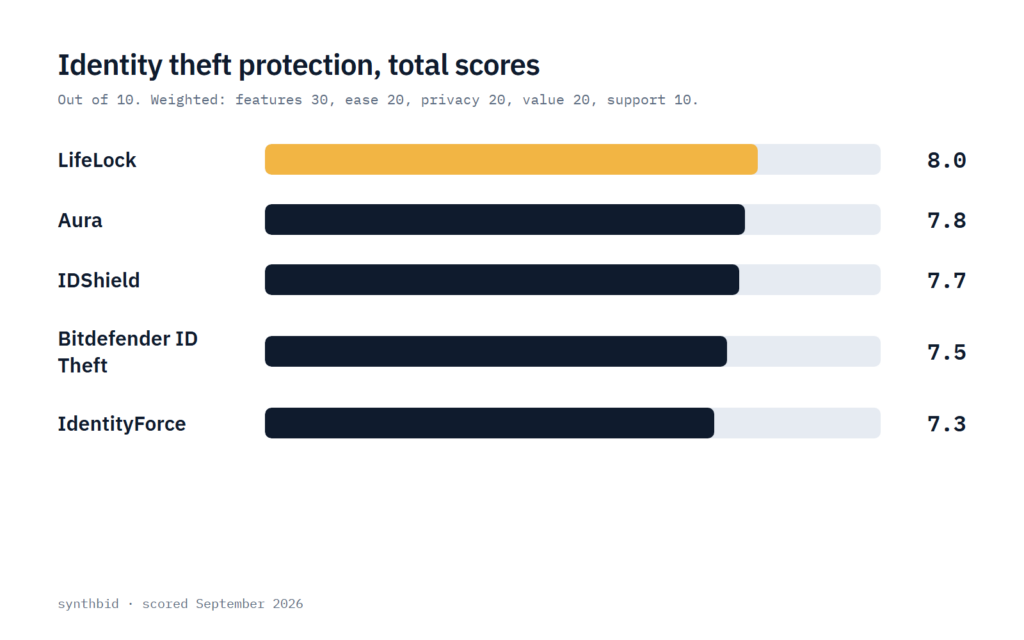
- LifeLock ranks first because its Total plan covers the widest ground, with up to $3M of reimbursement, and its price climbs steeply from tier to tier.
- Aura is a close second at 7.8: three-bureau monitoring and $1M of insurance per adult, with device extras that are thin.
- No service here can freeze your credit for you, and a freeze is free, so I would do that first and pay only for the monitoring, restoration help and insurance you will use.
Five identity theft protection services are ranked here. Each earns a score out of 10 on five checks, and the checks carry different weight: features count for 30, then 20 each for ease of use, privacy and value, and 10 for support, as the How I test page explains. Each company publishes a plan page that lists what every tier includes and costs, so plans and prices come from those pages and the judgement calls come from reviews. The gaps between the scores are small, so read the sections on price and renewal before you pay for a year.
What you are paying for
These services sell three things: an alert when your details turn up somewhere they should not, a restoration team that does the legwork after a theft, and insurance for the cost. They do not sell prevention. One roundup makes the point that alerts only flag a problem after the fact, and that freezing your credit at all three bureaus is free and is the step that blocks new accounts, which a company cannot do for you.
The insurance figure is a ceiling, not a payout. The policy fund mostly pays lawyers, investigators and other experts to repair the damage, and some policies also reimburse money stolen directly, so the headline number says little about what lands in your account. That reimbursement is often capped lower: on LifeLock the cap is $25K on Core, $100K on Advanced and $1M on Total.
Paying makes the most sense if you have already been a victim, were caught up in a breach, will not freeze your credit, or know you will not check your own reports. If you will do that work yourself, the free steps at IdentityTheft.gov cover much of the same ground.
The ranking at a glance
| Product | Score | Price | Best for |
|---|---|---|---|
| 1. LifeLock | 8.0 | from $10.42/mo, billed yearly | The widest cover for one adult, if you accept the price |
| 2. Aura | 7.8 | from $12/mo, billed yearly | Three-bureau monitoring at a lower entry price |
| 3. IDShield | 7.7 | from $14.95/mo | Families that want one flat family plan |
| 4. Bitdefender Identity Theft Protection | 7.5 | from $69.99 for the first year | A low first-year price, with a higher regular price |
| 5. IdentityForce | 7.3 | from $19.90/mo | Daily credit reports, at the highest prices here |
Prices from each company’s plan page, checked September 2026. The Pricing section below lists every plan.
LifeLock: best overall
LifeLock sells three tiers, Core, Advanced and Total, and the gap between them is wide. Core monitors two credit bureaus and watches up to 2 bank or credit accounts for alerts. Advanced moves to three bureaus and up to 5 accounts. Total allows unlimited accounts and adds home title monitoring and investment account alerts, and it is the tier that earns the top spot.
Insurance scales the same way. Reimbursement for identity theft is up to $1.05M on Core, $1.2M on Advanced and $3M on Total, and the stolen-funds limit rises from $25K to $100K to $1M. Advanced adds $5K of scam reimbursement and Total adds $10K, though that cover is not offered to New York residents. One review also notes social media monitoring, and the page says the automatic data broker removal submits requests every 90 days.
The restoration guarantee promises a refund for the current term if you are not satisfied with the resolution, with restrictions. The trade-off is the price ladder: Total costs $29.17 a month billed yearly at $349.99, or $34.99 billed monthly. The page says its discounts apply to the promotional period only and the standard price follows, and a roundup warns that the top tier jumps at auto-renewal. The renewal figure is not on the page, so I would check it at checkout.
Why 8.0. Core features score 9.0 for the Total plan’s range of monitoring, cover and extras. Ease of use gets 8.0, since a mid-2026 revamp made the pricing easier to follow. Privacy gets 7.5 and value 7.0, because the strongest tier costs the most here. Support gets 8.0 for phone help at any hour and a guarantee with a refund behind it.
Scores: core 9.0, ease 8.0, privacy 7.5, value 7.0, support 8.0. Total 8.0.
Aura: close behind, with three bureaus on every adult plan
Aura prices by the number of people covered and not by feature tier. Individual is $12 a month billed yearly for 1 adult and 10 devices, Couple is $22 for 2 adults, and Family is $32 for 5 adults with unlimited kids and devices. Insurance is $1M per adult, which makes $1M, $2M and $5M across the three. Compared with LifeLock, the first tier with three-bureau monitoring costs less here.
Each adult plan includes three-bureau credit monitoring, home and auto title monitoring, transaction alerts, antivirus, a VPN and a password manager. The plan page describes the instant credit lock as covering your Experian file, which is why I would freeze the other two bureaus myself, and one review says all three can be frozen from its credit section, so check what your version offers. Aura’s plans page says data removal reaches 425+ sites, while a roundup gives 140+ in one place and over 200 in another. I treat it as a convenience and send people who care about removal to my data removal ranking.
The weak spots: the Family plan is $50 a month billed monthly, though one roundup lists $45, and one review reports a March 2026 phishing attack that exposed 900,000 records, mostly names and email addresses, with no Social Security numbers or financial data. Only that source reports it, so check Aura’s own notice. My Aura review goes through the plans in full.
Why 7.8. Core features score 8.5 for the breadth of one subscription, held back by the Experian-only lock. Ease of use gets 8.0 and privacy 7.0, because of the amount of data held and the March incident. Value gets 7.5 and support 7.5, the same scores as in the review.
Scores: core 8.5, ease 8.0, privacy 7.0, value 7.5, support 7.5. Total 7.8.
IDShield: best for families
IDShield keeps it simple: an Individual plan and a Family plan, both with every feature. The page lists Individual from $14.95 a month and Family from $29.95, and the family plan brings Social Security number monitoring for a partner and dependents under 18, with up to 15 devices. One review says the family device count rises from three to 15 and that the plan covers all your minor children.
You pick one-bureau or three-bureau credit monitoring, and the page says the bureaus monitored vary by plan. A roundup quotes $19.95 a month for three bureaus on the individual plan and $34.95 on the family plan. I expect the lower starting prices on the page are the one-bureau option, but the page does not itemize it. The page also promises identity fraud protection of up to $3 million and a licensed private investigator on your case.
Extras come from Trend Micro, with antivirus for 3 devices, a VPN and a password manager. The same review finds the VPN and password manager basic and says the reputation tool wrongly flags many photos. Its data tool scans for you on broker sites and leaves the choice to remove it to you, which I like. One roundup warns that frequent alerts can train you to ignore them.
Why 7.7. Core features score 8.0 and ease of use 7.0, since noisy alerts and false photo flags cost points. Privacy gets 7.5 for a data tool that leaves the removal decision to you. Value gets 8.0 for the family price, and support gets 8.0 for a licensed investigator and restoration at any hour.
Scores: core 8.0, ease 7.0, privacy 7.5, value 8.0, support 8.0. Total 7.7.
Bitdefender Identity Theft Protection: the lowest first-year price
Bitdefender sells two plans. Standard is $69.99 for the first year, against a regular price of $129.99, with credit monitoring at up to 1 bureau and up to $1 million of insurance. Premium is $99.99 for the first year, against $209.99, with up to 3 bureaus and up to $2 million, plus ransomware and social engineering refunds of up to $25,000 each.
The page’s comparison list includes bank, card and investment alerts, change of address and court record monitoring, a credit score simulator and a lost wallet service, and it says the service requires a valid Social Security number. One review notes that $60 added to the $129.99 standard price buys Bitdefender’s top device security suite, which adds a VPN and a password manager, so compare the bundle if you also need antivirus.
Independent coverage of the standalone identity plans is thinner than for the others, since the reviews I could find concentrate on the suite. That leaves me leaning on the plan page for ease of use and support, and it is why those two scores sit lower.
Why 7.5. Core features score 8.0 for the monitoring list and the reimbursement cover. Ease of use and privacy each get 7.5. Value gets 7.0, because the regular price is much higher than the first-year price, and support gets 7.0 because the page offers little detail on how to reach the recovery team.
Scores: core 8.0, ease 7.5, privacy 7.5, value 7.0, support 7.0. Total 7.5.
IdentityForce: detailed monitoring at a high price
IdentityForce has two individual tiers. UltraSecure is $19.90 a month after a 30-day trial, or $199.90 a year, with $1 million of identity theft insurance. UltraSecure+Credit is $34.90 a month or $349.90 a year and adds three-bureau monitoring and daily TransUnion credit reports and scores, with $2 million of insurance. Both include a dedicated restoration specialist and a VPN for mobile.
A family plan adds a second adult and up to 10 kids under 18. A roundup lists the family UltraSecure+Credit plan at $39.90 a month or $399.90 a year. One review praises the dashboard but calls the mobile apps poorly rated, says the financial tools sit behind the higher tier, and lists no data removal.
The sources disagree on insurance: the same review’s bottom line says $1 million while its spec table says $2 million per adult. I follow the vendor page, which gives $1 million and $2 million by tier. The page also carries a TransUnion copyright, and a roundup advises against credit monitoring products sold by the bureaus, which is part of why privacy scores lower here.
Why 7.3. Core features score 8.0 for the credit monitoring and the daily reports. Ease of use gets 7.5, since the dashboard is good and the apps are not. Privacy gets 7.0 and value 6.5, because the credit tier costs almost as much as LifeLock Total. Support gets 7.0, and one review’s spec table lists no 24/7 support.
Scores: core 8.0, ease 7.5, privacy 7.0, value 6.5, support 7.0. Total 7.3.
Which one I would pick
- One adult who wants the widest cover and will pay for it: LifeLock Total, at $349.99 a year.
- One adult who wants three-bureau monitoring for less: Aura Individual at $144 a year, against $199.99 for LifeLock Advanced, the first LifeLock tier to monitor three bureaus. That is a gap of $55.99.
- A couple: Aura Couple at $264 a year, against $359.99 a year for two adults on LifeLock Advanced, a gap of $95.99.
- A family with children: IDShield Family from $29.95 a month, or Aura Family at $384 a year for 5 adults and unlimited kids.
- A tight budget: Bitdefender Standard at $69.99 for the first year, with a regular price of $129.99 and monitoring at one bureau.
Pricing
| Plan | Price | Billed | Insurance |
|---|---|---|---|
| LifeLock Core | $10.42/mo | $124.99 a year, or $12.49 monthly | Up to $1.05M |
| LifeLock Advanced | $16.67/mo | $199.99 a year, or $19.99 monthly | Up to $1.2M |
| LifeLock Total | $29.17/mo | $349.99 a year, or $34.99 monthly | Up to $3M |
| Aura Individual | $12/mo | $144 a year, or $15 monthly | $1M |
| Aura Couple | $22/mo | $264 a year, or $29 monthly | $2M |
| Aura Family | $32/mo | $384 a year, or $50 monthly | $5M |
| IDShield Individual | from $14.95/mo | Monthly | Up to $3 million |
| IDShield Family | from $29.95/mo | Monthly | Up to $3 million |
| Bitdefender Standard | $69.99 first year | Regular price $129.99 | Up to $1 million |
| Bitdefender Premium | $99.99 first year | Regular price $209.99 | Up to $2 million |
| IdentityForce UltraSecure | $19.90/mo | $199.90 a year | $1 million |
| IdentityForce UltraSecure+Credit | $34.90/mo | $349.90 a year | $2 million |
Prices from each company’s plan page, checked September 2026.
The first-year price is not the whole story. LifeLock says its discounts cover the promotional period only, and its Norton 360 with LifeLock Select bundle costs $99.99 for the first year and renews at $159.99. Bitdefender shows $69.99 beside a regular $129.99 for Standard, so I would budget for the higher figure.
Trial and refund terms differ. Aura offers a 14-day free trial and a 60-day money-back guarantee on annual plans, counted from the trial sign-up date if you started with a trial. LifeLock refunds eligible annual plans within 60 days. IdentityForce charges you when its 30-day trial ends unless you cancel first.
On entry price alone, LifeLock Core is $19.01 a year cheaper than Aura Individual, at $124.99 against $144, but it monitors two bureaus where Aura monitors three.
FAQ
What is the very best identity theft protection?
On my scores it is LifeLock, with the Total plan for the widest cover. Aura is close behind at 7.8 and costs less at the entry level. Before you pay for either, freeze your credit at the three bureaus, which costs nothing.
What’s better than LifeLock?
Nothing beats it on my scores, but Aura comes closest. It monitors three bureaus on every adult plan where LifeLock Core covers two, and Aura Individual is $12 a month billed yearly. IDShield suits families better, and my Aura review sets out the weak spots.
Is identity theft protection worth paying for?
Partly. You can freeze your credit and check your reports for free, but dark web monitoring is something you cannot do yourself, and a restoration team saves time if the worst happens. If you will not do the free steps, paying is more defensible.
Can I cover my children?
Yes, on the family plans. Aura Family covers 5 adults and unlimited kids, IDShield covers dependents under 18, and IdentityForce lets you add up to 10 kids under 18. LifeLock’s family plans cover up to 10 minors through LifeLock Junior.
Sources
- LifeLock, plans page
- LifeLock, home page
- Aura, plans page
- IDShield, home page
- Bitdefender, identity theft protection page
- IdentityForce, home page
- PCMag, best identity theft protection software
- NerdWallet, identity theft protection services compared
- TechRadar, best identity theft protection
- TechRadar, Aura review
- FTC, IdentityTheft.gov
- How I test